About 120 years ago, Dr. Alois Alzheimer first observed the plaques and tangles that characterize Alzheimer’s disease. Now a research team led by Xiuli Dan, Paul D. Robbins and Vilhelm A. Bohr has reported mitochondrial plaques in AD patients that might be another therapeutic target for the disease. These findings were published in a recent issue of Nature Neuroscience.
Mitochondrial Plaques in Alzheimer’s Disease Patients
Alzheimer’s disease (AD) is a major cause of death, and its incidence is increasing as the number of older individuals also grows worldwide. More than 120 years ago, Alois Alzheimer described the two types of protein aggregations that characterize the disease: intracellular tangles of tau protein and extracellular plaques of amyloid protein. Tragically, although substantial effort has been made to link those protein aggregations to the disease pathogenesis, the cause of AD is still unknown.
Now a research team led by Xiuli Dan, Paul D. Robbins and Vilhelm A. Bohr has reported mitochondrial plaques in AD patients that might be another therapeutic target for the disease. These findings were published in a recent issue of Nature Neuroscience.
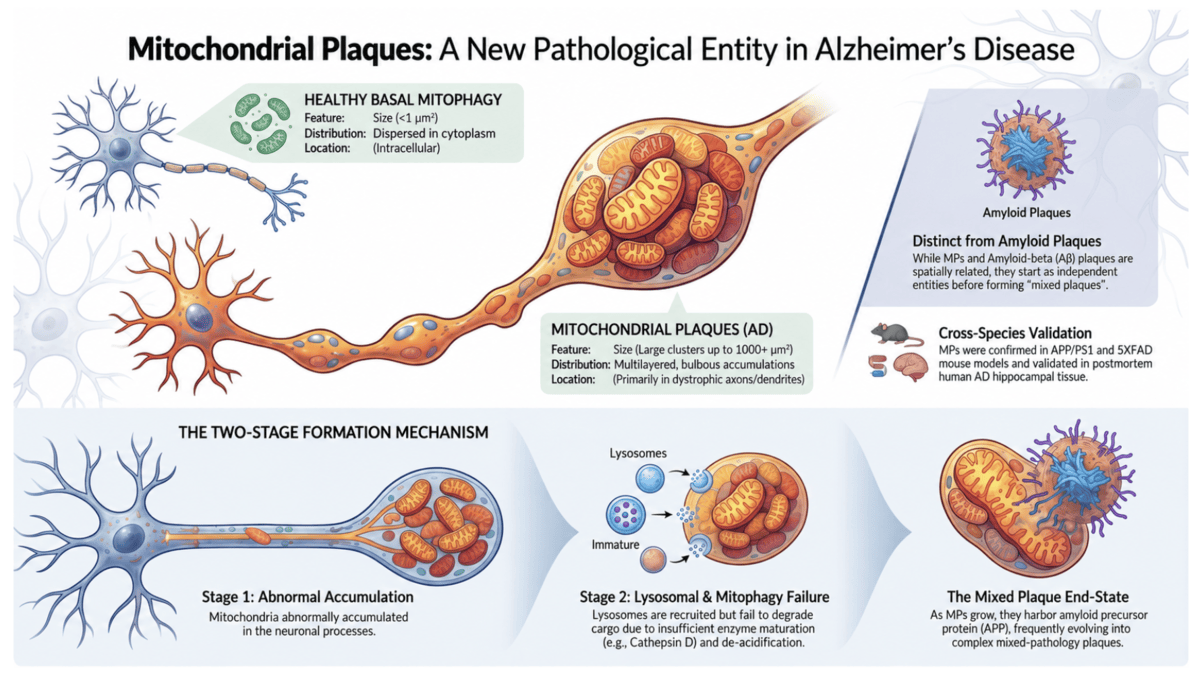
Mitochondria have also been implicated in AD by dysfunctional mitophagy, and the research team sought to explore that potential connection. To facilitate their work, they used a pH-sensitive mitochondrial reporter. The fluorescent reporter, Keima, is expressed in mitochondria, and in that neutral pH environment, it is green. In the acidic environment of the lysosome, it is red. The team found lots of acidic mitochondrial aggregations in the cortex and hippocampus in a mouse AD model that expresses Keima in the mitochondria and they call the mitochondria-aggregated structure mitochondrial plaques. They observed none in the control mice. They also found similar structures in AD human brains, but not controls.
The mitochondrial plaques are consistent with impaired degradation of proteins and mitochondria. They might also affect the AD disease process by interfering with neurites, mitophagy and lysosome function. In any case, the study results implicate the mitochondrial plaques in AD and represent an intriguing new possible therapeutic target.
A Statement of Significance by Drs. Dan, Robbins and Bohr
Alzheimer’s disease is characterized by progressive neuronal dysfunction, but the cellular mechanisms underlying this dysfunction remain incompletely understood. In our Nature Neuroscience manuscript, we identified mitochondrial plaques (MPs) as a previously unrecognized form of mitochondrial pathology in AD. We demonstrated that abnormal mitochondrial accumulation in neuronal processes precedes impaired lysosomal degradation, resulting in the persistence and accumulation of damaged mitochondria into plaque-like structures. MPs are present in both AD mouse models and human AD brains, supporting their clinical relevance. Our findings reveal a previously unrecognized link between mitochondrial accumulation and lysosomal dysfunction in AD and suggest that future research on MPs may provide new opportunities for understanding disease mechanisms, developing biomarkers of neuronal dysfunction, and identifying therapeutic targets. Our work also adds to the increasing body of information supporting that mitochondrial dysfunction is one of the earliest steps in AD progression.
A Discussion with Drs. Dan, Robbins and Bohr
MitoWorld: These findings are very interesting, especially given the lack of a clear mechanism for AD and the known involvement of defective mitophagy in AD. Can you give us an idea of how you intend to further this research?
Drs. Dan, Robbins and Bohr: Defective mitophagy appears to contribute to the development of MPs, but it may not be the only underlying mechanism. Our data suggest that abnormal mitochondrial accumulation may occur early and serve as an initiating factor in MP development. In future studies, we aim to understand why abnormal mitochondria preferentially accumulate in certain neurons in AD and to identify strategies to prevent or target this pathological accumulation.
MitoWorld: Most neurodegenerative diseases feature protein aggregations. Might those diseases other than AD also have mitochondrial plaques?
Drs. Dan, Robbins and Bohr: It is possible that MPs may also occur in other neurodegenerative diseases, but this remains to be determined. We are interested in investigating whether similar mitochondrial pathology is present across different neurodegenerative diseases.
MitoWorld: Experiments in mice have provided valuable insights into the pathogenesis of neurodegenerative diseases, but they have not also been translatable to human studies. Can you speculate on that problem and how it might fit in your results?
Drs. Dan, Robbins and Bohr: We addressed this issue by including human brain samples in our current study and confirmed that MPs are also present in human AD brains, supporting their clinical relevance. However, we do not yet know how early MPs arise during the progression of AD in humans. Determining when MPs emerge during human disease progression will be an important direction for future studies.
MitoWorld: Do you have a model in mind for how the mitochondrial plaques form and are associated with AD?
Drs. Dan, Robbins and Bohr: As discussed in the paper, we propose that MPs formation involves two interconnected processes. First, abnormal mitochondria accumulate within neuronal processes, which may be an early initiating event. Second, defective lysosomal degradation impairs the clearance of these accumulated mitochondria, allowing them to persist and progressively form MPs.
MitoWorld: Can you envision how your findings might be translated into clinical treatments?
Drs. Dan, Robbins and Bohr: MPs may provide both therapeutic and diagnostic opportunities. Because MPs reflect mitochondrial dysfunction and impaired mitochondrial clearance in neurons, targeting the processes that drive their formation or persistence may offer a new therapeutic strategy. In addition, MP-derived biomarkers could potentially enable earlier detection of neuronal dysfunction at the organelle level and help monitor disease progression or therapeutic responses.
MitoWorld: Can you tell us how you came to be interested in mitochondria?
Drs. Dan, Robbins and Bohr: We have been studying mitochondrial dysfunction in aging and age-related diseases for many years. This long-standing interest ultimately led us to investigate mitochondrial pathology in Alzheimer’s disease and to identify mitochondrial plaques as a previously unrecognized pathological structure.
Reference
Dan X, Croteau DL, Liu W, Chu X, McDevitt RA, Robbins PD, Bohr VA (2026) Mitochondrial accumulation and lysosomal dysfunction result in mitochondrial plaques in Alzheimer’s disease. Nature Neuroscience. https://www.nature.com/articles/s41593-026-02390-1#citeas