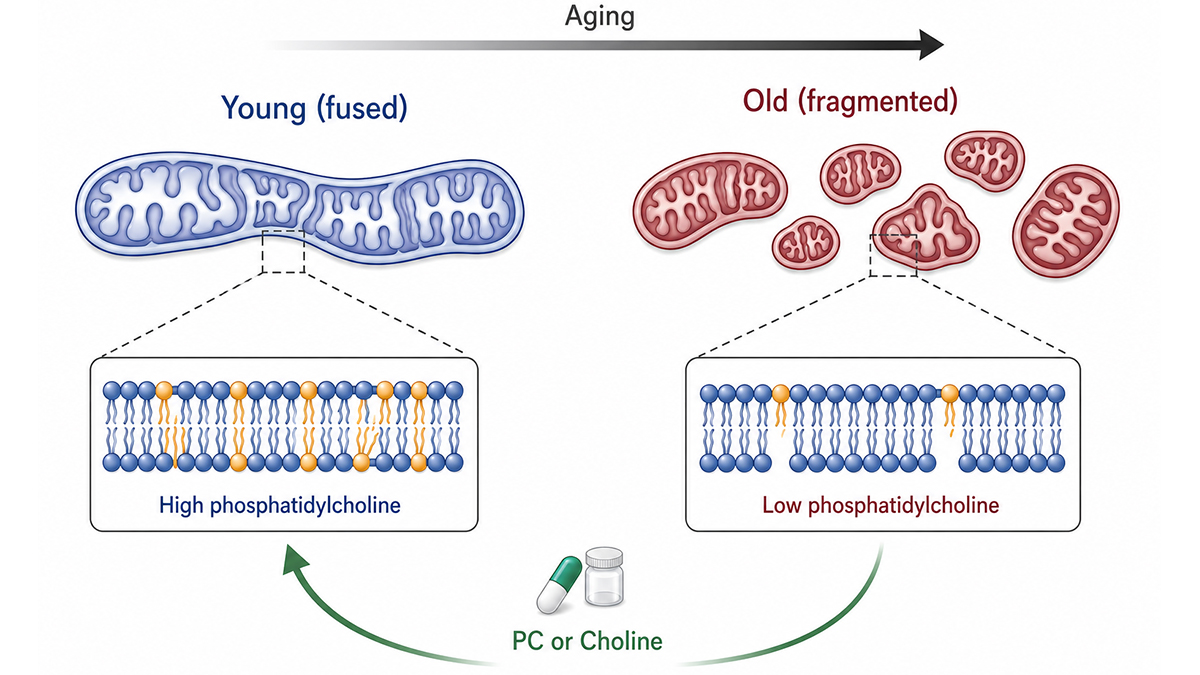
Mitochondrial dysfunction is a key feature of aging. A new study led by Maria A. Ermolaeva identified the decline of phosphatidylcholine synthesis as a trigger of mitochondrial network disruption. These findings could have important clinical implications. The results were published in Nature Communications.
Phosphatidylcholine and Mitochondrial Aging
Mitochondrial dysfunction is a key feature of aging and is intimately involved in the gradual loss of metabolic plasticity over time. While aging is linked to problems in mitochondria, the mechanisms are poorly understood, especially “natural aging.” A multi-institute research team led by Maria A. Ermolaeva of the Fritz Lipmann Institute in Germany sought to better understand the “natural causes” of mitochondrial aging. They identified the decline of phosphatidylcholine synthesis as a trigger of mitochondrial network disruption. These findings could have important clinical implications. The results were published in Nature Communications.
To explore the connection between mitochondria and aging, the Ermolaeva group used a combination of proteomics, lipidomics, genetics, and other tests in wildtype and mutant Caenorhabditis elegans to find pathways that support longevity. More specifically, they used longitudinal proteomics analysis, RNAi-mediated gene inactivation, and longevity testing to identify three enzymes whose levels decline markedly with age and whose reduced expression negatively affects mitochondrial function: SAMS-1 (S-adenosylmethionine synthetase 1), PMT-1 (phosphoethanolamine methyltransferase 1), and PMT-2 (phosphoethanolamine methyltransferase 2). All three enzymes share a common role in the methylation-dependent biosynthesis of phosphatidylcholine, a major component of cellular membranes. This connection led the researchers to investigate the role of phosphatidylcholine in mitochondrial aging.
Interestingly, they found that phosphatidylcholine levels do decline with age and adding additional phosphatidylcholine to the diet improved mitochondrial function in older animals and human cell cultures. Specifically, they found that choline supplementation protected human cells against metformin-induced mitochondrial dysfunction, suggesting that boosting phosphatidylcholine synthesis may help preserve mitochondrial resilience in humans.
The findings of the study strongly support a model in which the loss of phosphatidylcholine with age initiates a disruption of the mitochondrial network. Thus, effective phosphatidylcholine biosynthesis involving SAMS-1 and its human orthologs, seems to be required for longevity maintenance in the context of mitochondrial impairments. These results are likely to have interesting implications for health and disease
A Statement of Significance by Dr. Ermolaeva.
It has long been known that genetic impairments of mitochondrial function can cause premature aging, but what drives mitochondrial aging under natural conditions has remained largely unknown. Our study provides one of the first mechanistic explanations for this phenomenon, linking the loss of mitochondrial network connectivity—a well-known hallmark of aging—to reduced biosynthesis of the membrane lipid phosphatidylcholine (PC). Our data suggest that PC helps maintain mitochondrial membrane fluidity and flexibility, thereby promoting mitochondrial fusion, a process essential for metabolic plasticity and mitochondrial quality control. Importantly, our findings suggest that the contribution of declining PC levels to mitochondrial aging is conserved from C. elegans to humans. Most notably, we found that this defect could be corrected by dietary supplementation with PC or its precursor, choline, suggesting that at least one aspect of mitochondrial aging can be attenuated through a simple dietary intervention.
A Conversation with Dr. Ermolaeva.
MitoWorld: These are exciting findings. Can you tell us a bit about how you plan to extend these findings in your future research?
Dr. Ermolaeva: The next interesting question is whether all phosphatidylcholine species are equally effective at rescuing mitochondrial aging, or whether those with specific fatty acid tails work better than others. We have started a collaboration with another research group in Germany to investigate this.
MitoWorld: Several times, you refer to the mitochondrial network. Mitochondria do seem to communicate in some manner, such as when they are exchanged between cells. Can you elaborate on that network for our readers?
Dr. Ermolaeva: By mitochondrial network, we refer to the interconnectedness of mitochondria within a cell. Mitochondria are highly dynamic, constantly undergoing fission and fusion. Fission is needed to remove damaged mitochondria, while fusion helps improve bioenergetic efficiency. Healthy cells can freely adjust these dynamics depending on their current needs, but aging cells gradually lose their ability to fuse mitochondria, leading to a progressive decline of energy output and metabolic plasticity. Our work identified at least one mechanism of why this happens.
MitoWorld: You noted that the life stages of the nematodes differed: middle age showed changes in stress responses and old age showed chromatin-related changes. Do you have any thoughts about why that might be?
Dr. Ermolaeva: This was an unbiased proteomics experiment looking at differences in protein expression across life stages. The original aim was to understand at what stage of aging metabolism begins to break down. We found that this happens relatively late in life, possibly as a consequence of the earlier decline in stress responses and quality control pathways. Interestingly, changes in proteins involved in epigenetic regulation also appeared to be a relatively late event during aging.
Although still speculative, epigenetic regulation depends on specific metabolites, such as alpha-ketoglutarate, whose availability is partly linked to mitochondrial metabolism. So it is possible that our findings point to a tentative timeline of how aging unfolds: first, stress responses and quality control mechanisms decline, potentially contributing to subsequent changes in metabolism, which may in turn influence epigenetic regulation. Of course, aging is highly complex, but this sequence may capture at least part of what happens during aging.
MitoWorld: Your work focused on the mitochondria, but phosphatidylcholine is used in all membranes. Did you observe any other changes in the nematodes?
Dr. Ermolaeva: This is a good question. In our assays, we focused only on mitochondria, but both the age-related decline in phosphatidylcholine levels and their restoration through dietary supplementation likely affect the function of other cellular membranes as well, at least to some extent.
MitoWorld: Your findings could have clinical implications. Do you plan to follow up on any of those?
Dr. Ermolaeva: Possibly, we will do this if we discover that particular forms of phosphatidylcholine are especially effective at restoring mitochondrial function during aging. Otherwise, choline supplementation, which boosts PC production through an alternative pathway that appears to be less affected by aging, is already used to support liver and brain health.
MitoWorld: We at MitoWorld are obviously very interested in mitochondria. Can you tell us what it was that originally interested you in mitochondria?
Dr. Ermolaeva: Our interest in mitochondria was sparked by an earlier study published in Nature Metabolism in 2020. In that study, we investigated whether the lifespan-extending effects of the antidiabetic drug metformin also occur in older animals. Strikingly, we found that the same dose of metformin that extends lifespan in young C. elegans kills up to 80% of older animals within the first 24 hours of treatment. Intrigued by this observation, we investigated the underlying mechanisms and discovered that mitochondrial aging was the main reason for this difference. In young animals with healthy mitochondria, metformin triggers pro-longevity metabolic remodeling, while in older animals with dysfunctional mitochondria, it causes a sharp decline in ATP production that can be lethal for small organisms like nematodes. These findings made us realize just how important mitochondrial aging is, not only for the aging process itself but also for the effectiveness of anti-aging interventions. This motivated us to investigate mitochondrial aging further, and we have more work on this topic coming out soon.
Reference
Poliezhaieva T, Li Y, Chaudhari PS, Isildak U, Alonso-Pernas P, Valentim IS, Su F, Espada L, Bayar M, Fu L, Koeberle A, Dönertaş HM, and Ermolaeva MA (2026) Aging-associated decline of phosphatidylcholine synthesis is a malleable trigger of natural mitochondrial aging. Nature Communications 17(1): 3589. https://www.nature.com/articles/s41467-026-71508-7.pdf