Keystone’s Integrative Mitochondrial Medicine puts metabolism beside structural biology, genetics beside synthetic biology, new technology beside clinical applications, and a Shark Tank beside the podium. Scholarship & Abstract Deadline is December 1.
Not Your Ordinary Mitochondria Conference
Integrative Mitochondrial Medicine | March 21–24, 2027 | Fairmont Banff Springs, Banff, Canada | Program and Registration
December 1, 2026 is the deadline.
Short talk abstracts and scholarship applications both close that day.
Discounted registration closes January 19, 2027.
Poster abstracts close March 1, 2027.
Trainees and early-career investigators can:
- Submit a short talk abstract for the opportunity to present your work alongside field leaders
- Apply for a scholarship to help make attending possible
- Join the Career Roundtable to get advice from field leaders in academia and industry
Early in your career, being in the right room can change your career trajectory. Most mitochondrial meetings put you in a room with people who study what you study. This one does not, and that is the point. What makes this Keystone Symposia on Integrative Mitochondrial Medicine unusual and a must-attend event for graduate students and postdocs, rather than reading about it afterward?
1. The Conference Catalyzes Integration, rather than Describing It
The program bridges cell and structural biology with dynamic metabolite profiling and bioenergetics. That sounds like a standard conference line until you consider how rarely those communities share a program, and what happens when scientists bridge these specialties. Six disciplines on one program. The organizers are betting that the connections nobody has made are sitting in the gaps between them.
2. The Technology is the Highlight, not the Footnote
The program spans cryo-electron tomography to genome editing. Imaging that resolves cristae architecture, editing tools that reach the mitochondrial genome, engineered proteins that redirect mitochondrial gene expression, and computational modeling that treats the organelle as part of a network. Each of those would fill its own meeting. Put them on one program and the question changes from what mitochondria do to what can now be done to them to treat disease.
3. Who Is Running It, and What they Bring to the Table
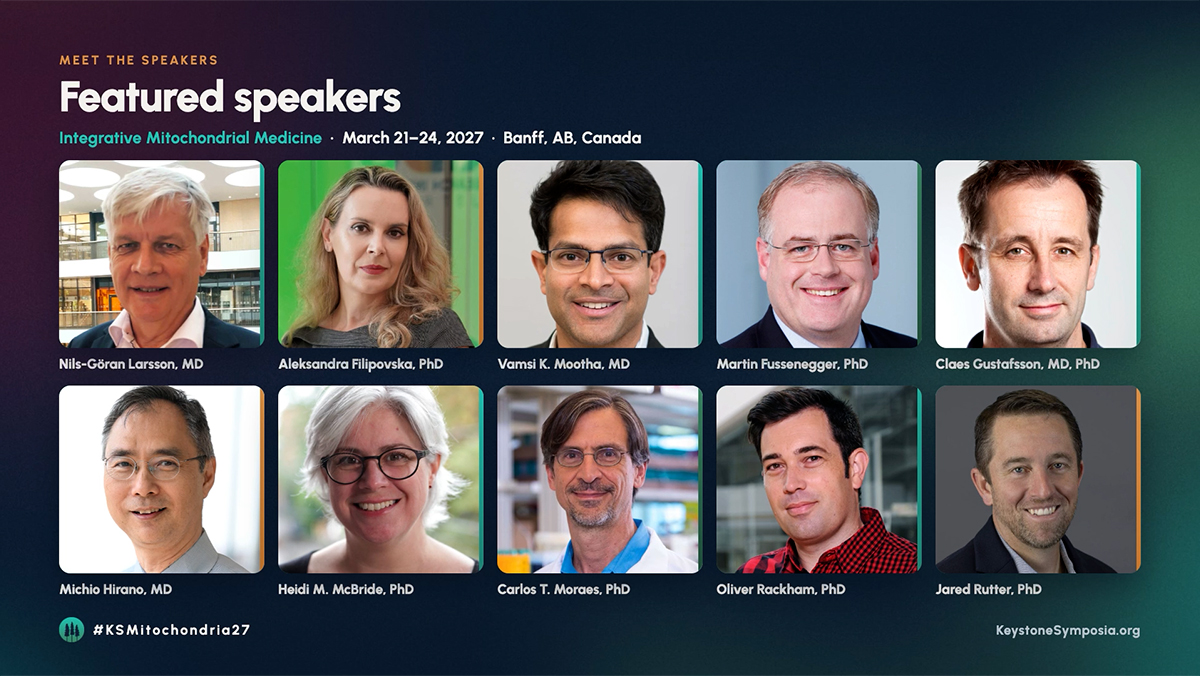
The two scientific organizers are not a ceremonial pairing. They are working from opposite ends of the same problem– how to use mitochondria to treat disease– and the combination is the clearest statement of what this meeting aspires to- a venue where mitochondrial medicine transforms from theory to reality.
Nils-Goran Larsson, Karolinska Institutet
Larsson built the field of mitochondrial genetics. In 1998 he showed that mitochondrial transcription factor A is required for mitochondrial DNA (mtDNA) maintenance and for embryonic development, which established how the mitochondrial genome is held together at all. In 2004 his group published the mtDNA mutator mouse, which carries a proofreading-deficient mtDNA polymerase, accumulates mtDNA mutations and ages prematurely. That finding moved mtDNA damage from correlation to causation of aging, and it remains one of the most cited results in the field. He went on to become a founding director of the Max Planck Institute for Biology of Ageing in Cologne. In 2016 moved to the Karolinska Institutet to lead the Department of Medical Biochemistry.
Aleksandra Filipovska, University of Western Australia
Filipovska builds the tools for mitochondrial manipulation. Her laboratory works on how mitochondrial gene expression is controlled, and on engineering RNA-binding proteins designed to leverage that knowledge to influence gene expression. She is Deputy Director of the ARC Centre of Excellence in Synthetic Biology, an NHMRC Investigator, and was elected a Fellow of the Australian Academy of Science this year.
4. There is a Shark Tank, and it is Not Decoration
Investigators pitch and a panel of investors responds, in the room, in front of everyone. “It is not simply theatre or a pitch competition. For a trainee this is the rarest thing on offer. Most conferences will tell you what the science is. Very few will tell you, in public and to your face, what it would take to move your science out of the laboratory and toward a patient.” (From our earlier interview with the organizers)
There is also a session on commercialization and a Career Roundtable with people from academia and industry. The program is designed to educate attendees how to drive their science from discovery to real impact.
We caught up with the program speakers to get their thoughts about the meeting, and what makes it special for early-career scientists:
MitoWorld: Why is this theme different from other general mitochondrial gatherings?
Antentor O. Hinton, Jr., Assistant Professor of Molecular Physiology and Biophysics, Vanderbilt University (Program Speaker): A remarkable aspect of this symposium is its integration of mitochondrial imaging, bioenergetics, metabolic networks, genetics, synthetic biology, and precision medicine. Bringing these disciplines together creates opportunities to identify connections that might otherwise be overlooked.
Jared Rutter, Distinguished Professor of Biochemistry, University of Utah (Program Speaker): The metabolism and structural biology additions are unusual in mitochondrial medicine conferences, but are important to understand the biology and medicine. Mitochondrial-nuclear communication is key to understand mitochondrial biology and its impact on medicine. Many of the consequences of mitochondrial defects eventually impinge on the nucleus and transcription.
Read our Exclusive Interview with the organizers here!
MitoWorld: Why is this symposium in particular useful for early career investigators, graduate students and postdocs to attend?
Antentor O. Hinton, Jr.: Unlike larger conferences, where interactions can sometimes be limited, Keystone meetings provide an exceptional opportunity for junior faculty members, trainees, and established investigators to engage directly with one another, challenge existing ideas, and discuss where the field should go next.
MitoWorld: Why is this symposium important for you?
Antentor O. Hinton, Jr.: Having the opportunity to present our discoveries on the same scientific stage as internationally recognized leaders is both humbling and empowering. It allows us to demonstrate how our laboratories are contributing new perspectives while receiving valuable feedback that can strengthen our research directions and accelerate our scientific growth.
Bringing together the scientists who helped establish the field, those who are advancing it today, and those who will define its future.
What to Do Before December 1
- Submit a short talk abstract.
- Apply for a scholarship in the same sitting. Same deadline.
- Register at the student rate before January 19 and save three hundred dollars against the regular rate.
- If you cannot travel, the livestream and on demand options are far cheaper and still carry the program. Livestream and On Demand fees can be found here.
In-Person Fees
Student rate (until Jan. 19): $1,045
Early registration (until Jan. 19): $1,345
Regular rate: $1,595
Abstract fee: $50
Conference Information
Conference: Integrative Mitochondrial Medicine, Keystone Symposia
Dates: March 21–24, 2027
Location: Fairmont Banff Springs, Banff, Alberta, Canada
Scientific Organizers: Nils-Goran Larsson, Karolinska Institutet, and Aleksandra Filipovska, University of Western Australia
Scholarship and short talk abstract deadline: December 1, 2026
Discounted registration deadline: January 19, 2027
Poster abstract deadline: March 1, 2027
Program and registration: here
Applicants should check the conference page for up-to-date abstract, scholarship and registration deadlines, since these can change as the meeting approaches.