Extended spaceflight presents many challenges to the human body, including the immune system. Recently, a team, led by Daniel Winer, Alexander Chouker, Christopher Mason and Brian Crucian, described those challenges and strategies for maintaining immune health in future astronauts. The review was published in Nature Reviews Immunology.
Spaceflight, Mitochondria, and the Immune System
Extended spaceflight presents many challenges to the human body, including the immune system. Effects have been particularly well-documented in the immune system. Recently, a team, led by Daniel Winer, Alexander Chouker, Christopher Mason and Brian Crucian, described those challenges and strategies for maintaining immune health in future astronauts. The review was published in Nature Reviews Immunology.
Humans evolved in an Earth-bound environment that featured gravity and a degree of protection from radiation. However, extended spaceflight presents many challenges to the human body. One of the most critical systems that might be negatively affected is the immune system. The many existing studies on space and the immune system, which have been elaborated by recent multiomic analyses, established the foundations of a new research field called astroimmunology.
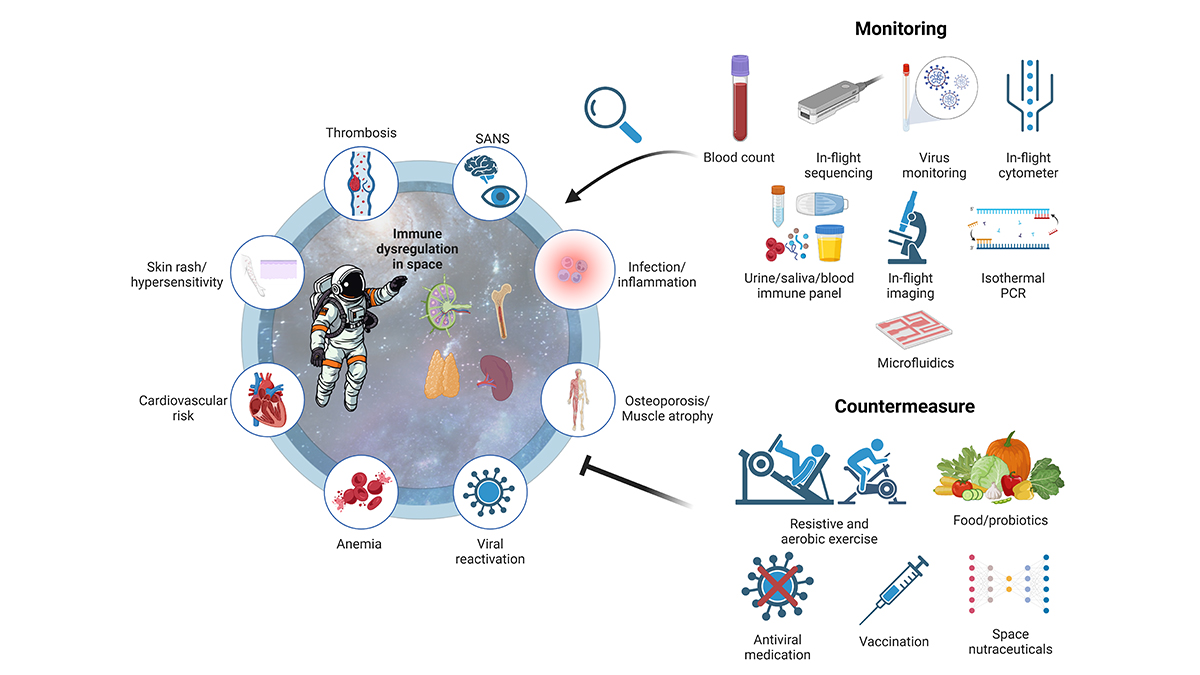
For humans, space is a hostile environment with many threats, such as microgravity and cosmic radiation. In addition, microbes of the human microbiome display increased virulence, antibiotic resistance, biofilm formation and more. Space travel increases psychological stress and disturbances to circadian rhythms that affect the immune systems. For example, even minor respiratory infections seemed to be more common among early space station residents. If we are able to establish ourselves on the moon or Mars, new challenges from those environments will appear. All of these can impact our cellular health.
Unfortunately, it is hard to study these on the ground. There really is no substitute for experiments in space. It will be important to continue to explore the effects of space on human health as the number of flights increases. This outstanding review covers the many challenges and possible strategies to mitigate those effects. As spaceflights grow longer and longer, these studies will become even more important
A Statement of Significance by Dr. Winer.
The immune system is one of the body’s systems most impacted by spaceflight, typically showing a combination of basal low-grade inflammation from innate cells, coupled to reduced robustness, including by some adaptive immune cells, such as T cells. Since the immune system influences many physiological processes across the body, and its dysfunction contributes to most chronic diseases of aging, it is important to understand how changes to the immune system during spaceflight will ultimately contribute to astronaut health. Our work provides a comprehensive contemporary guide to understand how and why the immune system changes from stressors linked to spaceflight. It also covers pertinent topics like host-microbiome interactions, aging, clinical risks, countermeasures to boost immune function in space, immune monitoring, and how risks associated with living on the Moon or Mars could impact immunity.
A Conversation with Dr. Winer.
MitoWorld: Can you tell us the particular directions that your own research might take to further the findings described in this outstanding review?
Dr. Winer: We are currently working on a number of projects to better understand how changes in gravity, including simulated microgravity, impact immune cell function. We are also particularly interested in understanding how simulated microgravity can be used to recapitulate aspects of biological aging in the immune system. Working with the David Furman lab and Cosmica Biosciences, we have shown that 24 hours of simulated microgravity can induce aging trajectories in cells that overlap with natural processes as far as 9 years out. Thus, microgravity offers a chance to develop interesting new forms of prognostic markers in aging research. This test is the BeyondAge biological aging recently released by Cosmica Biosciences.
MitoWorld: The immune system is obviously critical to human health. Are you aware of other systems that are affected by spaceflight? For example, astronauts typically return from extended flights with atrophied muscles?
Dr. Winer: Spaceflight impacts most physiological systems, and in addition to the immune system, many astronauts will experience some declines or changes in musculoskeletal, endocrine, cardiovascular, and neurological systems (including sensorimotor), among others. We are particularly interested in the immune system since in theory, it plays a role in modulating so many diseases, such as cardiovascular diseases, musculoskeletal, metabolic, cancer, and neurodegenerative diseases. Thus, by studying the immune system, we can find potentially useful applications across many different diseases of aging, and complications of spaceflight.
MitoWorld: While you are focusing on space travel, could your findings have implications for clinical work here on Earth?
Dr. Winer: Yes. Since spaceflight stressors like microgravity and radiation alter fundamental cellular properties, such as DNA damage repair, mitochondrial function, cytoskeletal regulation, and inflammatory signaling, among others, all of which impact human diseases on Earth, we may learn more about fundamental processes driving such diseases. Such knowledge could be useful in designing new therapies, or biomarkers as alluded to previously.
MitoWorld: Can you briefly summarize the involvement of mitochondria in the effects on the immune system during spaceflight?
Dr. Winer: Mitochondria are key organelles that control immune cell activation, polarization, and programming. Through metabolic reprogramming, they can dictate the type of immune response that occurs in cells. For instance, pro-inflammatory macrophages and T cells often exhibit disturbed tricarboxylic acid cycles in the mitochondria, leading to increased usage of other pathways, such as glycolysis and the pentose phosphate pathway, that can support inflammation. During spaceflight stressors, we see a number of similarities. With simulated microgravity exposures, we see reduced mitochondrial oxidative phosphorylation across many immune cells, and this mitochondrial dysfunction can hamper immune cell functions. In addition, mitochondrial dysfunction in immune cells can lead to increased reactive oxygen species production which can also fuel inflammation. Finally, mitochondrial damage due to radiation from spaceflight can cause danger molecules to leak from the mitochondria and either lead to cell death or incite inflammation from cells. Thus, the mitochondria are a central hub impacted by spaceflight stressors on cells.
MitoWorld: Given the many challenges that you have cataloged with spaceflight, are you still hopeful about long-term space existence?
Dr. Winer: Yes! The study of astroimmunology and the impact of spaceflight on other physiological systems is still very young. For many years, due to technological limitations, most of these studies centered on basic phenotyping work, where we would see things, such as immune dysfunction, but not really understand fully in depth why the changes were occurring. However, now with more advanced techniques, such as many of the multiomic analyses as well as equipment that can perform terrestrial-like workflows in space, coupled to the increase of commercial spaceflights, we are seeing a major rapid expansion in knowledge understanding how spaceflight influences the body. With this new emerging knowledge, combined with other technologies, such as AI, I think that humanity will be in good position to develop robust countermeasures to facilitate safe space travel. Long-term space existence will no doubt continue to offer new challenges, but I am hopeful that such challenges can be overcome through interdisciplinary modern, and even futuristic approaches.
Reference
Winer DA, Du H, Kim J, Chang V, Burke M, Winer S, Costes SV, Frippiat JP, Sams C, Paul AM, Wu H, Ullrich O, Baatout S, Beheshti A, Mason CE, Choukér A, Crucian BE (2025) Astroimmunology: The effects of spaceflight and its associated stressors on the immune system. Nat Rev Immunol 26:189–212.
doi: 10.1038/s41577-025-01226-6.