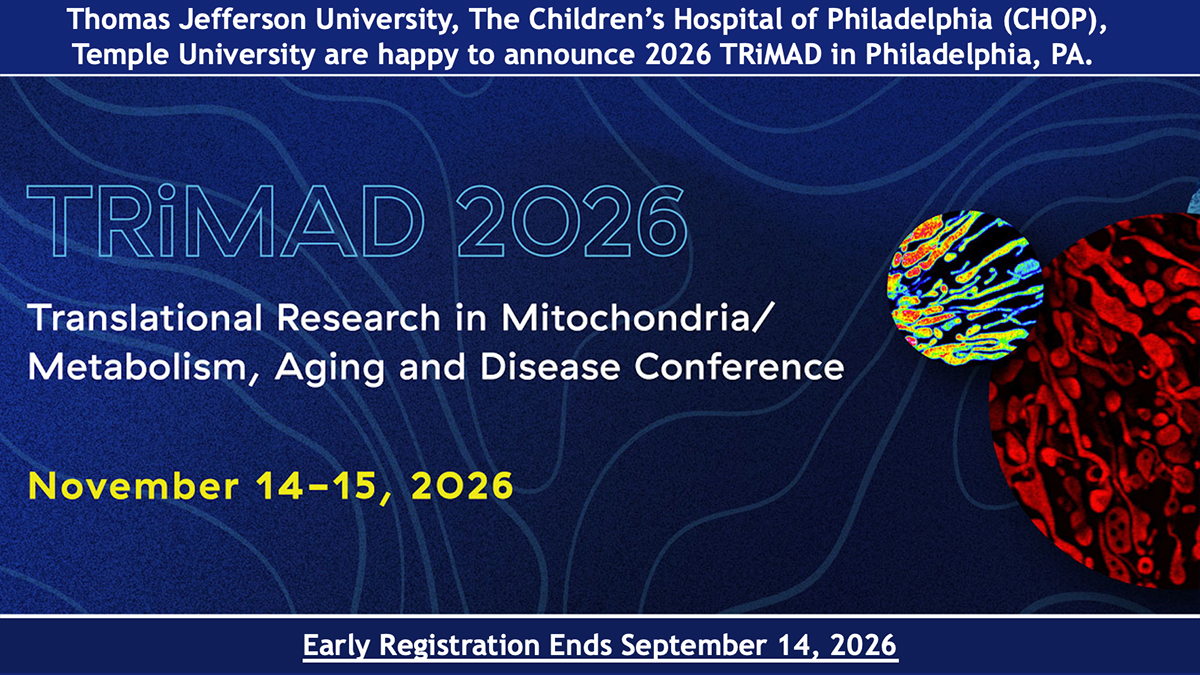
TRiMAD 2026, Early registration ends September 14 for an unusually accessible two-day gathering of leading mitochondrial researchers. There are not many opportunities to spend two days in one place with mitochondrial researchers from the NIH, Harvard Medical School, Dana-Farber Cancer Institute, Memorial Sloan Kettering Cancer Center, The Wistar Institute, University of Pennsylvania and Boston Children’s Hospital — alongside three of the major mitochondrial research centers in Philadelphia. TRiMAD 2026 is one of them.
TRiMAD 2026: Mitochondrial Science Comes Together in Philadelphia
TRiMAD 2026, Early registration ends September 14 for an unusually accessible two-day gathering of leading mitochondrial researchers.
There are not many opportunities to spend two days in one place with mitochondrial researchers from the NIH, Harvard Medical School, Dana-Farber Cancer Institute, Memorial Sloan Kettering Cancer Center, The Wistar Institute, University of Pennsylvania and Boston Children’s Hospital — alongside three of the major mitochondrial research centers in Philadelphia.
TRiMAD 2026 is one of them.
The Translational Research in Mitochondria/Metabolism, Aging and Disease Conference — TRiMAD — returns to Philadelphia November 14–15 for two concentrated days of mitochondrial science, from fundamental mitochondrial biology to cancer, cardiovascular and neurological disease, aging, metabolism and primary mitochondrial disease.
And unlike many major scientific meetings, TRiMAD remains deliberately accessible: early registration is just $125 for trainees and $200 for faculty. The early-registration deadline is September 14.
Three Philadelphia Centers Bring the Meeting Together
TRiMAD is organized by three institutions that have built significant mitochondrial research programs within a few miles of one another:
Thomas Jefferson University’s MitoCare Center, directed by György Hajnóczky, MD, PhD, brings together advanced imaging, mitochondrial phenomics and disease models to understand mitochondrial function and dysfunction across cells, tissues and disease.
Children’s Hospital of Philadelphia’s Center for Mitochondrial and Epigenomic Medicine, directed by Douglas C. Wallace, PhD, spans mitochondrial genetics and basic research through advanced diagnostics, translational science and clinical mitochondrial medicine.
Temple University’s Aging + Cardiovascular Discovery Center, led by John Elrod, PhD, brings mitochondrial biology into the study of cardiovascular disease and aging.
Together, these centers make Philadelphia an unusual concentration of mitochondrial research — and provide TRiMAD with a scientific range that extends well beyond any single definition of “mitochondrial disease.”
A Remarkable Group in One Room
The 2026 program brings some of the best-known names in mitochondrial science together with investigators pushing the field into new areas of medicine.
Dario C. Altieri, MD — The Wistar Institute. Dr. Altieri brings cancer squarely into the mitochondrial conversation. President and CEO of Wistar and Director of its Ellen and Ronald Caplan Cancer Center, his research explores mitochondrial mechanisms that allow cancer cells to adapt, survive and progress.
Zoltan Arany, MD, PhD — University of Pennsylvania. Chair of Penn’s Department of Physiology. Dr. Arany studies the molecular mechanisms linking metabolism and mitochondrial function with cardiovascular physiology and disease.
Edward Chouchani, PhD — Harvard Medical School, Dana-Farber Cancer Institute and HHMI. Dr. Chouchani is helping define a newer generation of mitochondrial research connecting metabolism, redox biology and mitochondrial signaling to cancer and metabolic disease.
Agnel Sfeir, PhD — Memorial Sloan Kettering Cancer Center. The PaineWebber Chair in Cancer Genetics at MSK. Dr. Sfeir investigates genome stability and mitochondrial DNA biology, bringing another important connection between mitochondria and cancer to TRiMAD.
Richard J. Youle, PhD — National Institutes of Health. An NIH Distinguished Investigator, Youle has been central to the discovery and understanding of mitochondrial quality control, including PINK1/Parkin-mediated mitophagy and its relationship to Parkinson’s disease.
Thomas Schwarz — Boston Children’s Hospital and Harvard Medical School. Dr. Schwarz studies how neurons maintain mitochondrial health, with a particular focus on mitochondrial transport, positioning, and local quality control/mitophagy in axons.
Rebecca Ganetsky — Children’s Hospital of Philadelphia. Dr. Ganetsky is a physician-scientist focused on primary mitochondrial diseases, particularly mitochondrial Complex V/ATP synthase disorders and mtDNA deletion syndromes, with an emphasis on connecting molecular defects to clinical phenotypes. Her translational work also develops new biochemical diagnostics and functional biomarkers of mitochondrial activity to improve diagnosis, disease monitoring, and ultimately therapeutic development.
Dmitry Temiakov — Thomas Jefferson University. Dr. Temiakov studies the molecular machinery that controls mitochondrial gene expression, using structural biology and biochemistry to define the mechanistic principles of mitochondrial DNA replication and transcription initiation. His work also examines how these processes are altered in disease or involved in physiological processes, like maternal inheritance of mitochondrial DNA.
John Elrod of Temple — Temple University. Dr. Elrod studies mitochondrial calcium signaling, metabolism, fibrosis, and cell death, particularly in the context of cardiac injury, heart failure, aging, and neurodegeneration. His lab is especially known for defining mechanisms of mitochondrial calcium transport and how altered calcium handling reshapes energy metabolism and contributes to disease.
More Than Keynotes
TRiMAD is designed for scientific exchange rather than simply a sequence of major lectures. Nine invited speakers will be joined by 20 short talks selected from submitted abstracts, two poster sessions and an opportunity to tour Jefferson’s MitoCare Center.
That makes the meeting particularly attractive for trainees and younger investigators who want their work seen and discussed alongside established leaders in the field.
TRiMAD began in 2011 as a way of bringing together mitochondrial researchers across the Pennsylvania-New York-Ohio-Michigan region. In 2026, its reach — and the range of mitochondrial biology represented — is considerably broader.
For MitoWorld, that breadth is particularly important. Mitochondria are increasingly being investigated not only in primary mitochondrial disorders, but across cancer, cardiovascular disease, neurological disease, metabolism, aging and other major areas of medicine. TRiMAD puts many of those conversations under one roof.
Don’t Miss the Early Registration Deadline: September 14, 2026
TRiMAD 2026
November 14–15, 2026
Dorrance H. Hamilton Building
Thomas Jefferson University
Philadelphia, Pennsylvania
Early registration through September 14:
Trainees — $125
Faculty — $200
Registration remains open through October 31, and abstracts may be submitted through October 14. Abstract presenters must be registered for the meeting.
MitoWorld will be following TRiMAD closely. This is the first of three MitoBlog posts leading up to the conference, including conversations with some of the scientists and organizers who are helping expand where mitochondrial science goes next.