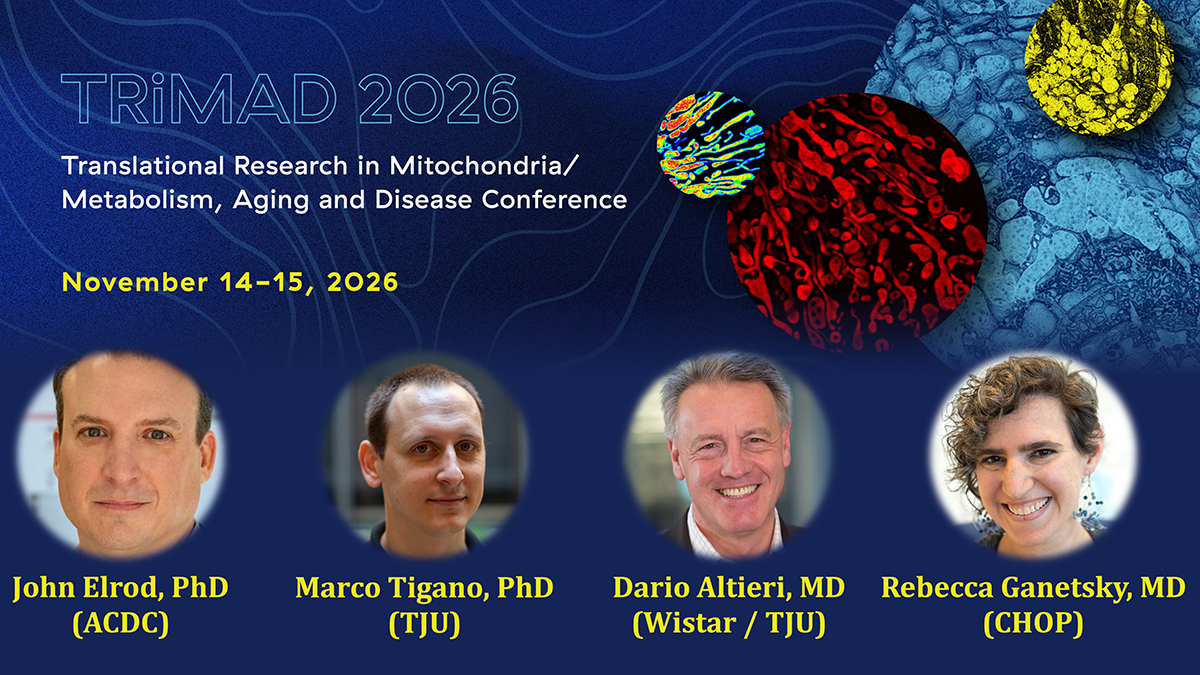
Four scientists behind TRiMAD 2026 on their science, their city, and the conference that brings them together
Philadelphia: A Mitochondrial City
Philadelphia has quietly emerged as a distinctive hub for mitochondrial science, bringing together researchers across fundamental biology, human genetics and disease, cardiovascular medicine and aging, and cancer, all working within the same scientific community. Within just a few miles of one another are research groups approaching mitochondria from remarkably complementary directions: mitochondrial calcium signaling, organelle communication and advanced imaging at Jefferson’s MitoCare Center; mitochondrial genetics, inherited disease and mitochondrial medicine at CHOP; mitochondrial signaling, calcium biology and metabolic regulation at Temple’s Aging + Cardiovascular Discovery Center; mitochondrial reprogramming and cancer metabolism at The Wistar Institute; and major programs in mitochondrial, nutrient and cardiometabolic metabolism at the University of Pennsylvania.
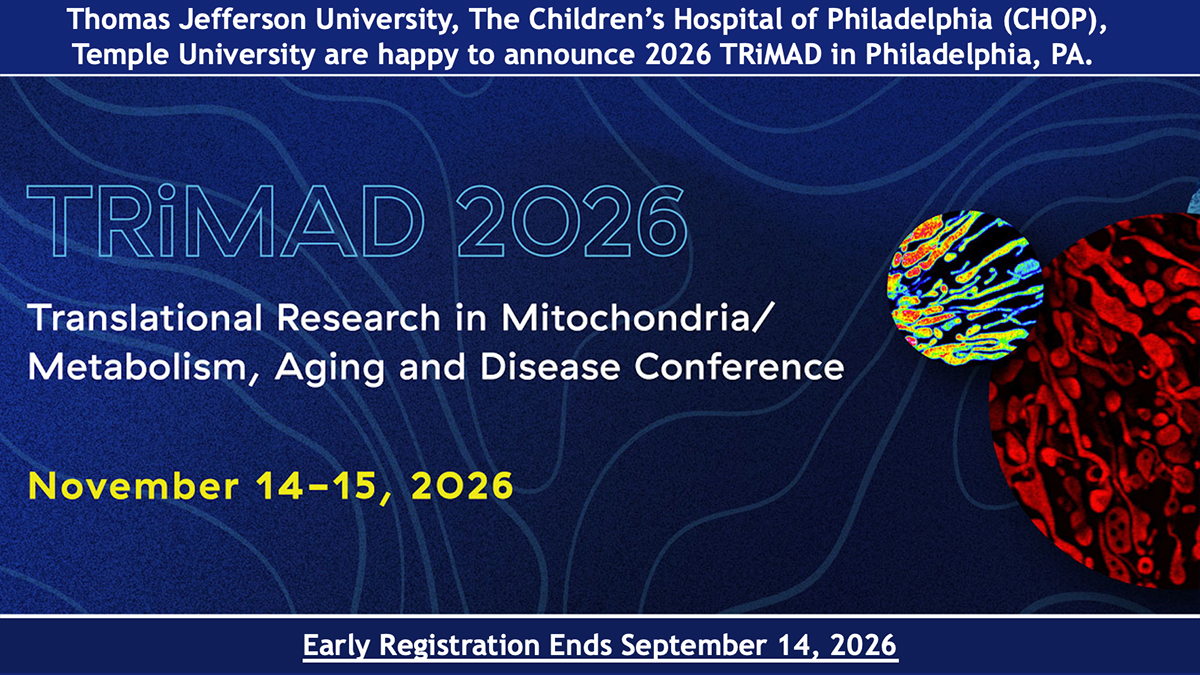
On November 14 and 15, a meaningful share of that community will sit in the same room at Thomas Jefferson University for TRiMAD 2026, Translational Research in Mitochondria/Metabolism, Aging and Disease, a community-run meeting that has been bringing mitochondrial scientists together for more than a decade, now returning to the city where much of that community actually lives and works. Jefferson, CHOP, and Temple co-sponsor this year’s meeting, with researchers from Wistar, U Penn, and institutions across the country joining them.
TRiMAD is not run by a scientific society, journal publisher, or conference company, a deliberate choice its organizers say gives them the freedom to focus on the science and the people rather than on scale. The program itself reflects that range with sessions on:
- mitochondrial quality control, gene expression, and structural biology;
- human mitochondrial disease and disease modeling;
- cardiovascular and aging research;
- neurodegeneration, metabolism, and cancer
With twenty talks chosen from submitted abstracts, the conference also gives younger researchers an unusually visible place in the program.
Mitochondria were taught principally as the structures responsible for cellular energy production. That description remains true, but it is increasingly incomplete. Mitochondria participate in calcium signaling, metabolism, cell death, innate immunity, epigenetic regulation, and communication between cellular compartments. Mitochondrial dysfunction is implicated not only in genetic mitochondrial diseases but also in cancer, cardiovascular disease, neurodegeneration, and aging. Philadelphia is unusually well-positioned for this broader mitochondrial era precisely because its institutions approach the organelle from such different directions. MitoWorld spoke with two of the scientists organizing this year’s meeting, and two additional prominent Philadelphia mitochondrial researchers joining as featured speakers. We talked about their own work, their city, and what they’re hoping will happen when this community sits down together in November.
Thomas Jefferson University, MitoCare Center
Marco Tigano, PhD, Assistant Professor, Department of Pathology & Genomic Medicine
MitoCare was established specifically around mitochondrial biology. Directed by György Hajnóczky, MD, PhD, the center combines advanced imaging with metabolic, genetic, and proteomic approaches and disease models. Its researchers investigate mitochondrial signaling, calcium handling, organelle interactions, metabolism, mtDNA, and disease mechanisms.
Tigano’s own laboratory studies mitochondrial DNA damage and mutation, and the signals damaged mitochondria send to the rest of the cell, including inflammatory and innate immune responses. He argues MitoCare’s real advantage isn’t its facilities: “The greatest strength lies in the colleague next to you.” MitoCare puts investigators with highly specialized mitochondrial interests in one environment, sharing instruments, models, reagents, techniques and perspective.
Children’s Hospital of Philadelphia, Mitochondrial Medicine
Rebecca Ganetzky, MD, Associate Professor; Director, Mitochondrial Biochemical Diagnostic Test Development
CHOP’s Mitochondrial Medicine Program and Center for Mitochondrial and Epigenomic Medicine have made Philadelphia one of the world’s major centers for studying and treating primary mitochondrial disease. Ganetzky provides medical care patients with mitochondrial disorders, while running a lab focused on developing better tools for measuring mitochondrial dysfunction, both to improve diagnosis and to determine whether treatments are working.
That patient population creates collaborations difficult to reproduce in a lab working alone. Ganetzky points to CHOP and Jefferson’s longstanding MitoCircle and MitoRAG seminar series and to ongoing collaborations with investigators across institutions. CHOP contributes patients with monogenic diseases and expertise in genetics, biomarkers, animal models, and clinical outcomes; Jefferson investigators bring complementary basic-science expertise in areas like mitochondrial calcium and phosphate transport and tRNA synthetase enzymology. For Ganetzky, this is also why clinical, translational, and basic research need to sit in the same room: patients reveal phenomena researchers don’t yet understand, and those observations move backward into the lab as often as discoveries move forward into the clinic.
Temple University, Aging + Cardiovascular Discovery Center
John W. Elrod, PhD, FISHR, William Wikoff Smith Chair in Cardiovascular Medicine, Founding Director, ACDC
Elrod’s laboratory has spent years investigating mitochondrial calcium signaling and the molecular machinery controlling calcium movement into and out of mitochondria, research with implications well beyond cardiology. Temple researchers now apply that biology to heart failure, ischemic injury, aging, and neurodegenerative disease, including Alzheimer’s disease. More recent work from the lab has challenged conventional thinking about exactly how calcium regulates mitochondrial metabolism.
The broader ACDC provides an interdisciplinary environment where mitochondrial biology intersects with cardiovascular physiology, neuroscience, metabolism, genomics, and translational medicine. That breadth is reflected in complementary programs across the center, including Elrod’s work on mitochondrial signaling and calcium biology and Nate Snyder’s work on metabolic regulation and disease metabolism. It is also the same cross-disciplinary spirit Elrod values in TRiMAD: a meeting where investigators often present new and still-evolving work rather than a polished talk already delivered many times. For trainees in particular, that creates an opportunity not only to hear where the field is going, but to meet the scientists who may help shape where their own work goes next.
The Wistar Institute, Ellen and Ronald Caplan Cancer Center
Dario C. Altieri, MD, President & CEO and Director
Altieri’s laboratory has investigated mitochondrial biology in cancer for roughly two decades, particularly how tumor cells exploit mitochondrial functions to survive, adapt, progress, and resist treatment. Cancer has become one of the clearest demonstrations that mitochondria are far more than passive power generators. Tumor cells reorganize mitochondrial metabolism and signaling to accommodate extraordinary stress, and understanding those adaptations may reveal vulnerabilities that can be therapeutically targeted.
Wistar’s participation reflects an already interconnected Philadelphia research environment. Wistar and Jefferson share technologies, collaborative pilot funding, and seminar activities. Researchers from Jefferson, Drexel, and Wistar recently received a major National Cancer Institute program project grant to study neuroendocrine prostate cancer. The timing carries its own significance. After more than a decade as Wistar’s President and CEO and more than sixteen years leading its Caplan Cancer Center, Altieri will leave his executive role at the end of 2026, joining Thomas Jefferson University on January 1, 2027 to return full-time to laboratory research and mentorship. For Altieri, that kind of bridge can’t be built administratively. Collaboration, he says, has to be “organic, bottom-up and intentional. It cannot be imposed.”
MitoWorld put the same set of questions to all four. Here is what they told us.
The Four Scientists
Marco Tigano, PhD
Thomas Jefferson University — MitoCare Center. Assistant Professor, Department of Pathology & Genomic Medicine, and TRiMAD 2026’s primary organizer.
Rebecca Ganetzky, MD
Children’s Hospital of Philadelphia — CHOP’s organizer for TRiMAD 2026. Associate Professor of Pediatrics, University of Pennsylvania; attending physician in Mitochondrial Medicine at CHOP.
John W. Elrod, PhD, FISHR
Temple University — co-sponsor of TRiMAD 2026. William Wikoff Smith Chair in Cardiovascular Medicine and founding Director of the Aging + Cardiovascular Discovery Center (ACDC), co-organizer of TRiMAD 2026.
Dario C. Altieri, MD
The Wistar Institute — featured speaker, TRiMAD 2026. President & CEO and Director of the Ellen and Ronald Caplan Cancer Center. Joins Thomas Jefferson University’s faculty January 1, 2027.
The Conversation
Q1. What makes Philadelphia such an unusual place for mitochondrial science?
Marco Tigano, Thomas Jefferson University
“It is always valuable to have colleagues nearby working on similar or related questions. It is invigorating to leave the lab, walk for 20 minutes, and find yourself at one of the top pediatric hospitals in the world: the Children’s Hospital of Philadelphia (CHOP), home to one of the largest programs for patients with primary mitochondrial disease. The same goes for the University of Pennsylvania, The Wistar Institute, and the translational research at Temple University’s Aging + Cardiovascular Discovery Center. And it doesn’t stop there: Drexel, Nemours Children’s Health, Rutgers, and many more offer excellent programs, all within short commutes. For me, collaboration is the key to science. Having world leaders in mitochondrial research within a few miles of each other makes a real difference, and it is an opportunity we can leverage even more.”
John Elrod, Temple University
“Jefferson and the MitoCare Center have tremendous expertise in mitochondrial signaling, imaging and physiology. CHOP brings extraordinary strength in mitochondrial genetics, mitochondrial medicine and human disease. At Temple, our ACDC has a major emphasis on mitochondrial mechanisms in cardiovascular disease, aging, metabolism, and neurodegeneration. Bringing those communities together creates something much larger than any one institution could do alone.”
Rebecca Ganetzky, Children’s Hospital of Philadelphia
Ganetzky points to what that complementarity looks like in practice: CHOP brings a large population of patients with monogenic genetic diseases, along with expertise in epigenetics, biomarker development, animal modeling, and clinical outcomes. MitoCare researchers contribute basic-science expertise in areas like mitochondrial calcium and phosphate transport and tRNA synthetase enzymology, capabilities that when combined with patient samples help to “more deeply characterize mitochondrial function and develop therapies.”
Dario Altieri, The Wistar Institute
“There is enormous potential to capitalize on the exceptional strengths of the academic institutions in the Philadelphia region to advance groundbreaking innovation in basic and translational research.” For Altieri, TRiMAD is positioned to become a catalyst for exactly that kind of interaction. This is fitting given Wistar and Jefferson’s own long track record of collaboration in cancer research, including shared technologies, pilot funding for joint projects, and the recent National Cancer Institute grant on neuroendocrine prostate cancer.
Q2. What makes TRiMAD different from other mitochondrial conferences?
Marco Tigano
“What makes TRiMAD special is that it is a community-driven meeting rather than one organized under the auspices of a larger society. This gives us the freedom to focus entirely on the science and the people, rather than on scale.”
Rebecca Ganetzky
“My favorite difference about TRiMAD is that it’s truly driven by the regional academic community, which is small enough that it can really focus on topics of mutual interest and naturally drive collaboration and engagement with each other’s research.”
John Elrod
“What sets TRiMAD apart is the breadth of mitochondrial science represented in one room. You can move from fundamental mechanisms to metabolism, cancer, cardiovascular disease, neuroscience, and human genetics in the same day. It is also small enough that those communities actually interact, which is where new ideas and collaborations often begin.”
Dario Altieri
“TRiMAD is unique for its central focus on mitochondrial research, its unwavering commitment to multidisciplinary collaboration among all participants, and strong emphasis on bridging the divide that still exists between laboratory advances and tangible opportunities in the clinic. On balance, this provides a unique combination that, in my opinion, is rare to find in other conference venues.”
Q3. What does TRiMAD offer younger mitochondrial researchers?
Marco Tigano
“One of my priorities as an investigator is to nurture the next generation of mitochondrial researchers, so I am particularly excited to see young investigators and trainees bring their best science. A community meeting like TRiMAD is the perfect venue for them to shine, gain exposure, and receive expert feedback.” Twenty abstracts will be selected for short talks, alongside two poster sessions and two poster prizes for young investigators. With no competing sessions, trainees don’t have to compete for faculty attention against a dozen other rooms.
John Elrod
“It has proven to be a particularly good meeting for trainees. They have a real opportunity to present their work, interact directly with leaders in the field and get noticed.” His hope: that trainees leave with real feedback, new contacts, and “perhaps having started collaborations that will shape where their work goes next.”
Dario Altieri
Altieri places support for “our trainees and junior colleagues” alongside scientific discovery and clinical translation as one of the central reasons interinstitutional collaboration matters. Bringing “new talents and new institutions under the same tent is vital for truly meaningful advances.”
Q4. What do you hope happens at TRiMAD 2026?
Rebecca Ganetzky
“I’m really hoping to hear about some exciting research, celebrate the work my colleagues have been doing and identify areas where we can work together to keep moving mitochondrial medicine and research forward.”
Dario Altieri
“I hope it will be a great day of mitochondrial science, broadening the interest in this fascinating and very important research across multiple, seemingly distant fields of biology and medicine.” Collaboration, he adds, “has to be organic, bottom-up and intentional. It cannot be imposed.” This statement may be as close to a motto for TRiMAD as any single line could get.
John Elrod
“If people leave TRiMAD with two or three new ideas they can’t stop thinking about on Monday morning, and a few trainees leave with new contacts or opportunities that advance their careers, then the meeting has done exactly what it should.”
TRiMAD 2026, at a Glance
Two full days, November 14–15, at Thomas Jefferson University. Nine senior speakers anchor the program, including Richard Youle (NIH), Zoltan Arany (U Penn), and Thomas Schwarz (Harvard) alongside Tigano, Ganetzky, Elrod, and Altieri, with roughly twenty trainee-selected short talks and two poster sessions built in around them. Registration is $150 for trainees and $250 for faculty, covering both days, coffee breaks, and lunch.
MitoWorld will have more on TRiMAD 2026 as the conference approaches, including a closer look at the program itself. Our first post on the conference is linked below as well.
TRiMAD 2026: Translational Research in Mitochondria/Metabolism, Aging and Disease
November 14–15, 2026 · Philadelphia, PA
Registration and full agenda: attend.jefferson.edu/event/trimad2026/summary · Session agenda
Registration: $150 trainees / $250 faculty
Our first post: TRiMAD 2026: Mitochondrial Science Comes Together in Philadelphia