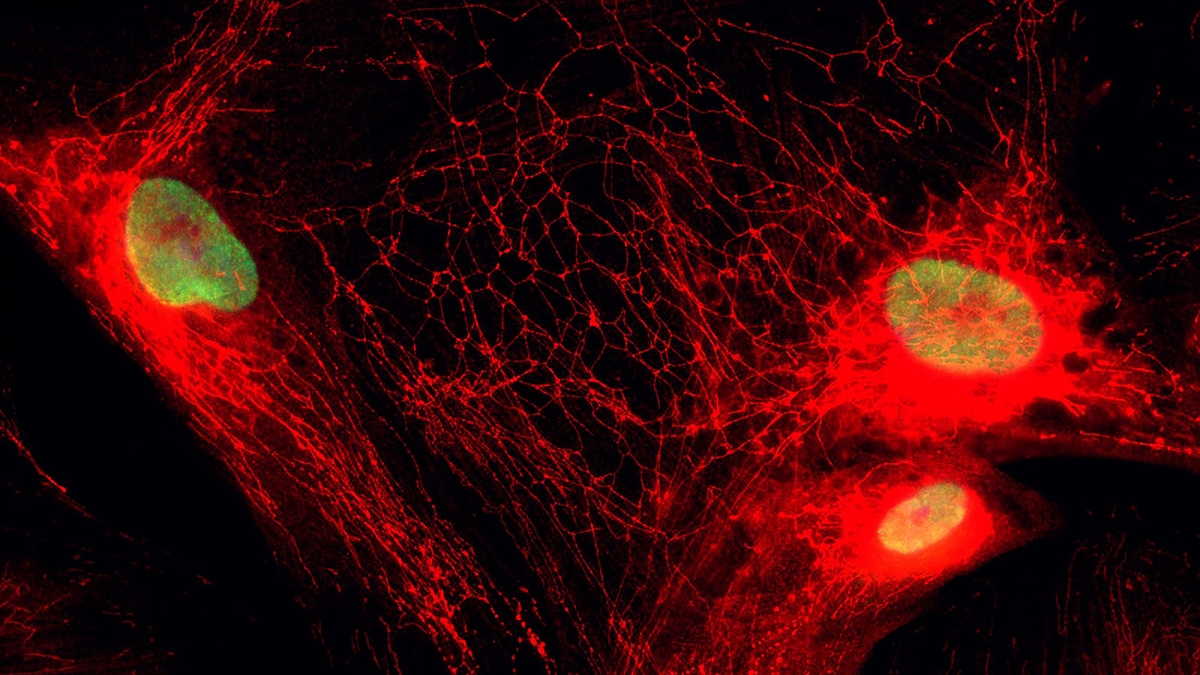
Mitochondria: From Stemness to Senescence
At the Fusion “Mitochondria & Cell Fate Transitions: From Stemness to Senescence” in
St. Julian’s, Malta, May 10–13, the organizers are bringing together are bringing together mitochondrial and STEM cell biologists to better understand cell-fate mechanisms.
The conference organizers, Drs. Mireille Khacho (University of Ottawa), Elisa Motori (University of Cologne), and Maria Eugenia Soriano (University of Padova), will bring together a range of researchers from different disciplines to connect mitochondrial dynamics, metabolism, redox signaling, and organelle communication with cell-fate decisions.
“Lots of exciting mitochondrial research is being done, but it tends to exist in silos,” said Dr. Khacho. “We want to break down those silos to get beyond simple correlations and on to a mechanistic understanding. As the title says, we want to cover mitochondria from stemness to senescence.”
The Conference will bring together leaders across mitochondrial biology, stem cell biology, aging, metabolism, and disease to explore how mitochondrial state actively governs cell fate transitions. Rather than treating mitochondria as passive bioenergetic organelles, the meeting centers on their roles as dynamic regulators of signaling, gene expression, immune crosstalk, and cellular identity across contexts ranging from development and regeneration to degeneration and senescence.
The Conference organizers have multiple goals. They hope to establish new conceptual frameworks for mitochondria-driven cell fate control, enable cross-disciplinary collaborations, and identify new therapeutic possibilities.
Arising frontiers and challenges will be featured. These include understanding the causality between mitochondrial remodeling and fate transitions, how mitochondrial diversity shapes distinct signaling trajectories and functional outcomes, how mitochondrial dynamics connects with transcriptional and epigenetic regulation, how mitochondria-driven senescence programs are distinct from classical damage-induced models, and how single-cell and spatial approaches can be integrated to capture mitochondrial function in vivo.
This meeting is specifically designed for investigators and trainees working in mitochondrial biology and dynamics, stem cell biology and regeneration, aging, senescence, and cell stress responses, cancer cell plasticity and immune–metabolic crosstalk, systems biology, metabolomics, and advanced imaging.
“The conference will be highly interactive plenty of early-career investigators and time for discussion,” said Dr. Khacho. “We hope to see you in Malta.”
For more information and to review the program and confirmed speakers, please visit the Fusion Conference webpage: https://fusion-conferences.com/conference/197.
Questions for the organizers:
MitoWorld: The Conference title (i.e., From Stemness to Senescence) covers a lot of ground. How did you pick the topics and speakers to bring this all together?
Organizers: The title was chosen to reflect both a biological continuum and a physiological trajectory, from normal stemness and regenerative capacity to pathological states, such as dysfunction, degeneration, and senescence. We deliberately selected topics and speakers that sit at key transition points, where cells change identity, competence, or trajectory, because these are moments when mitochondria their roles extending far beyond energy provision to encompass signaling, adaptation, and cell fate determination. Speakers were chosen for both scientific excellence and conceptual complementarity, bringing together perspectives from stem cell biology, aging, cancer, immunity, and neurobiology to create dialogue across traditionally separate fields.
MitoWorld: You have some outstanding goals for the Conference (e.g., “establish new conceptual frameworks for mitochondria-driven cell fate control”). What was the process to arrive at these, and will anyone attempt to synthesize any conclusions from the discussions?
Organizers: The goals emerged from ongoing discussions among the us three co-organizers, where a recurring challenge was the lack of shared frameworks linking mitochondrial changes to cell fate decisions. When FUSION announced the opportunity to propose a new conference topic, it felt like the right moment—a signal, almost—to turn our ongoing informal discussions into a collective effort. Rather than imposing predefined models, we designed the conference to allow concepts to evolve through discussion. We are planning moderated discussion sessions and thematic synthesis moments, and we intend to explore a post-conference summary or perspective to capture key insights, open questions, and future directions.
MitoWorld: Stem cells are a powerful tool, but also a subject in their own right. I understand you have a special connection to STEM cells and mitochondria. How do you hope the conference will be able to differentiate and yet combine these two goals?
Organizers: Stem cells offer a unique lens through which to study plasticity, commitment, and loss of regenerative potential, processes in which mitochondria play an instructive role. The conference does not treat stem cells as a niche topic, nor mitochondria as background machinery. Instead, stem cells are used as a conceptual framework to ask broader questions about how mitochondrial state encodes fate decisions, questions that extend naturally to aging tissues, cancer, and immune cells.
MitoWorld: Mitochondria research has had some controversies, one of which is the split between specific research findings or facts and adding more directly to basic scientific understanding. Do you anticipate that this Conference will provide an opportunity to re-set that balance?
Organizers: Yes. Many translational efforts in mitochondrial biology have been limited by incomplete mechanistic understanding, and we see real value in tightening that connection. This conference emphasizes mechanism-driven biology while remaining grounded in physiological and disease-relevant contexts. By bringing together basic scientists and translational researchers in a highly interactive format, we aim to foster a more integrated approach in which rigorous discovery and meaningful application inform one another.
MitoWorld: What specific provisions have you made to ensure that trainees will have quality time with the more experienced researchers? And in the future is there a way to make these events more accessible and affordable for them?
Organizers: We’ve been fortunate to build on the FUSION format, which inherently supports trainee engagement through its small size, shared meals, and extended discussion periods. This naturally creates space where early career researchers can interact meaningfully with more senior scientists. We further prioritized trainees through short talks selected from abstracts, dedicated poster sessions, “meet the poster presenters” session and informal networking opportunities. We have also worked diligently to secure funds, in the form of travel awards, for trainees and early career researchers.
MitoWorld: This Conference promises to be an outstanding event. What plans do you have to sustain the momentum?
Organizers: We’re pleased that the ambition and enthusiasm we’ve invested in this conference concept are immediately recognizable. We view this conference as the foundation of an ongoing scientific effort rather than a one-time event. Our intention is to establish Mitochondria & Cell Fate Transitions as a recurring meeting held every other year, creating continuity and an evolving forum for the field. Between meetings, we aim to sustain momentum through continued engagement via platforms such as MitoWorld. This structure allows ideas, debates, and emerging frameworks to mature over time while keeping the community connected and forward-looking.
Conference Organizers:
Mireille Khacho (University of Ottawa) investigates how physiological changes in mitochondrial dynamics and metabolism regulate stem cell fate, function, and regeneration. Her work focuses on mitochondrial-dependent metabolite and redox signaling in physiological contexts, and how disruption of these pathways drives neuromuscular diseases, aging and mitochondria-driven senescence.
Elisa Motori (University of Cologne) investigates how cell type–specific mitochondrial and metabolic programs shape brain health and disease vulnerability, revealing energy-driven mechanisms that govern development, resilience, and neurodegeneration.
Maria Eugenia Soriano (University of Padova) investigates how mitochondrial structure and dynamics are transcriptionally regulated to shape cellular metabolism. Using physiological and disease-relevant models, her work integrates mitochondrial biology, metabolic regulation, and gene expression to uncover how alterations in mitochondrial organization drive metabolic rewiring in cancer and other pathologies.