Interviews with academic and editorial co-organizers
Multifaceted Mitochondria, Indeed!
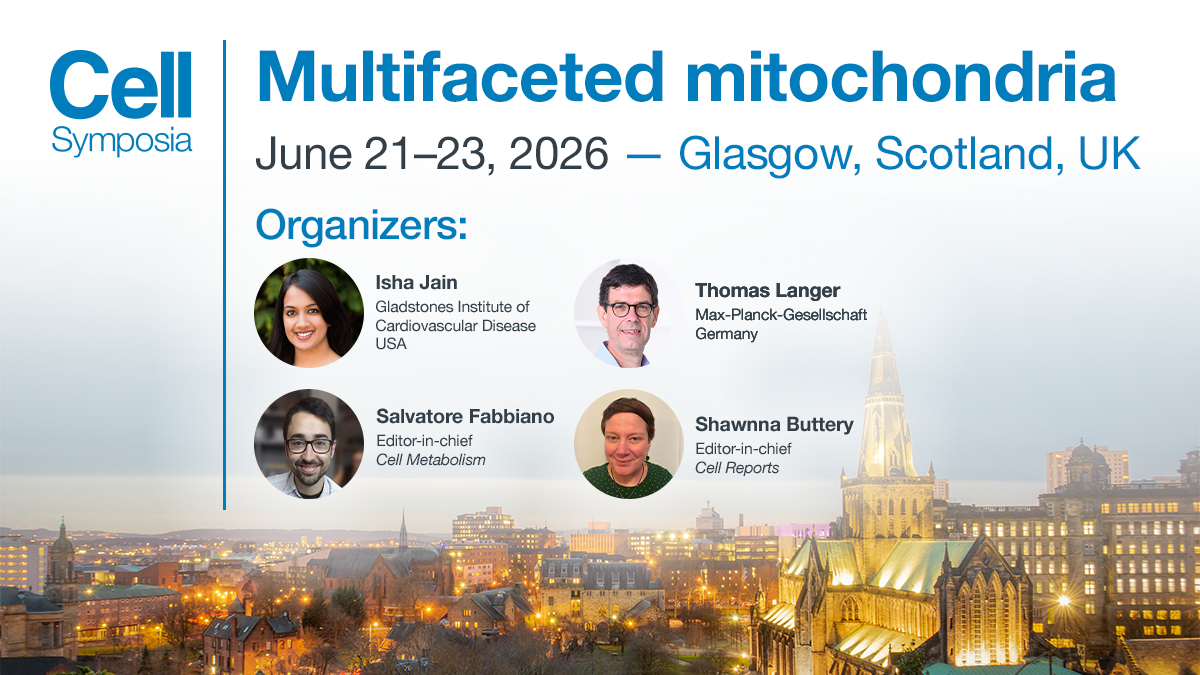
Get ready for the Cell, Multifaceted Mitochondria Symposium, this year in Glasgow, Scottland, June 21–23.
Like its five biennial predecessors, the Glasgow gathering features the hallmark of the Multifaceted Mitochondria Symposia—a broad and deep array of mitochondrial topics and talks, covering a number of areas of inquiring, including mitochondrial biochemistry and bioenergetics, mitochondria homeostasis and stress response, mitochondrial dynamics and transfer, mitochondrial communication, mitochondria in metabolism, and mitochondria in inflammation and disease. The 2026 event is organized by Isha Jain, Arc Institute and Gladstone/UCF and Thomas Langer, Max Planck Institute for the Biology of Ageing.
Keynotes
Keynote include Judy Hirst, University of Cambridge, and Jared Rutter, University of Utah.
Hirst is a British chemist and mitochondrial biologist at the University of Cambridge, where she is Director of the MRC Mitochondrial Biology Unit and Professor of Biological Chemistry. She leads research into the structure and mechanisms of mitochondrial respiratory enzymes, particularly respiratory complex I, using biochemical and structural methods to understand energy conversion. Hirst is a Fellow of the Royal Society and Fellow of the Academy of Medical Sciences, recognized for her contributions to mitochondrial biology.
Rutter is Distinguished Professor of Biochemistry and holds the Dee Glen and Ida Smith Endowed Chair for Cancer Research at the University of Utah where he has been on the faculty in the Department of Biochemistry since 2003. In 2015, Dr. Rutter was appointed as an Investigator of the Howard Hughes Medical Institute. The Rutter laboratory has identified the functions of several previously uncharacterized mitochondrial proteins, including the discovery of the long-sought mitochondrial pyruvate carrier.
History
The Cell Symposia series on Multifaceted Mitochondria, inaugurated in 2015 in Chicago, has charted the dynamic evolution of mitochondrial research over the past decade. The inaugural meeting focused on foundational themes, such as mitochondrial metabolism and bioenergetics, signaling pathways, mitochondrial dynamics, mitophagy, and quality control. The meeting brought together leaders exploring both basic mitochondrial functions and their intersections with disease, setting a strong mechanistic foundation for the field.
Since then, the symposium has progressively broadened its scope to capture the expanding complexity of mitochondrial biology. By 2022, Jodi Nunnari was the keynote, and the program integrated emerging topics, including mitochondrial communication with other organelles and immune signaling, mitochondrial proteostasis, and the role of mitochondria in inflammation and cancer metabolism. In 2024, several of the www.MitoWorld.org Scientific Advisory Board featured a MitoWorld Initiative. The latest 2026 program anticipates an even wider lens, framing mitochondria as central metabolic and signaling hubs influencing organismal homeostasis, aging, and multi-system diseases. This evolution reflects not only scientific advances but also a growing recognition of mitochondria as versatile regulators and therapeutic targets, a narrative underscored by recurring contributions from influential researchers.
Symposium organizers
Salvatore Fabbiano, Editor-in-Chief, Cell Metabolism, received his PhD in Physiology at the University of Salamanca, where he studied signaling pathways involved in cardiometabolic diseases. He then moved to the University of Geneva to work on host-microbiota homeostasis. He joined Cell Press in 2018.
Shawnna Buttery, Editor-in-Chief, Cell Reports, whose training in the laboratory was in cell biology, studying the cytoskeleton in nematodes as a graduate student at Florida State University and as a postdoc at Dana-Faber Cancer Institute. She has been with Elsevier/Cell Press since 2012.
Thomas Langer, academic co-organizer, who since 2018, has been Director at the Max Planck Institute for the Biology of Ageing in Cologne, focusing on the analysis of mitochondrial proteostasis and its regulation in ageing and age-associated diseases. Langer earned his PhD from the LMU Munich working on chaperone-mediated protein folding and was a researcher at the Memorial Sloan Kettering Cancer Center in New York and professor at the University of Cologne, where he studied the role of mitochondrial protein quality control in neurodegeneration.
Isha Jain, academic co-organizer, associate investigator at the Gladstone Institutes, as well as an assistant professor at UC San Francisco. Jain received her undergraduate degree in chemical and physical biology from Harvard University. There, she worked in the lab of Erin O’Shea on bacterial chromosome segregation. Subsequently, she joined the Harvard-MIT Program in health sciences and technology. She earned a PhD in computer science and systems biology and worked in the labs of Vamsi Mootha and Warren Zapol, where she made the discovery that hypoxia could serve as a therapy for mitochondrial disorders.
MitoWorld Interview
MitoWorld: What makes our Multifaceted Mitochondria meeting unique?
Fabbiano: The mitochondria field is extremely diverse, with researchers working on this organelle from signaling, structural, and bioenergetic perspectives and investigating how they affect cellular, tissue and whole-body homeostasis. This variety of angles is then put in the context of communicable and non-communicable diseases, spanning from the response to infections to metabolic and autoimmune disorders, cancer and aging.
Buttery: Multifaceted Mitochondria stands out because it embraces the full diversity of mitochondrial biology. It offers a comprehensive, top-to-bottom perspective on mitochondria, while bringing together a diverse group of scientists from across the field. This conference strikes a great balance of fresh perspectives and established expertise.
Jain: Because the symposium is intentionally small and highly interactive, you don’t just hear about exciting science; you immediately start brainstorming with the people behind it. That intimacy accelerates collaborations and often launches entirely new directions.
MitoWorld: Is there a risk of being too inclusive, with too many subjects? On the other hand, the field is still emerging. How do you strike a balance?
Fabbiano: The natural risk of such a broad field is thus the breaking down into silos and overspecialization, with each subfield narrowing down their perspective on the individual questions they are answering. Our vision and mission with this meeting are instead to go in the opposite direction, and we make it clear starting from the title: mitochondrial research is multifaceted, and should be appreciated as such to truly push the field forward. What makes us unique is our ongoing mission of strengthening the ties of a diverse community to create new channels of communication, new forms of collaboration, and develop ideas throughout a conference that welcomes both established leaders and emerging voices in the field.
Jain: Multifaceted Mitochondria is the rare meeting where every dimension of mitochondrial biology comes together—from metabolism and genetics to disease and therapy. It’s a unique opportunity to see the whole field at once and spark ideas that wouldn’t emerge in siloed settings.
MitoWorld: For the Glasgow symposium, what did you concentrate on. How did you determine the strands and the array of speakers? What do you hope people come away with?
Langer: It was of utmost importance to us to develop a program that only allows leading experts to discuss their most recent discoveries but also offers plenty of opportunities for young scientists to present their work and interact with other scientists in the field. We hope that the attendees will experience a vibrant and interactive scientific community and will leave with new tools, ideas and collaborators to further push forward the mitochondrial field.
Jain: Mitochondrial biology is advancing at an incredible pace, and this meeting is built to capture that momentum. We want participants to leave with new tools, new collaborators, and a clear sense of the frontier we’re all pushing toward.MitoWorld: What do you find exciting and challenging about organizing a Multifaceted Mitochondria Symposium, given the complexity of the fast-growing field and its many facets?
Langer: It is an exciting possibility and fun to bring together scientists working on different aspects of mitochondrial biology in a small and interactive setting to exchange their discoveries and ideas for new research directions. If I must mention something challenging, then that it is to select speakers among the many excellent scientists to build a program that covers the many aspects of mitochondrial biology and that allows us to identify synergies as a basis for future collaborations.
MitoWorld: It is refreshing to have a leading journal, in this case Cell Metabolism, take on a whole field-in-the making. It sounds like the journal has a hands-on approach with its communities.
Fabbiano: One point that makes us unique is the editorial involvement at these conferences, not only in the organization but in our very presence and engagement with the community. We appreciate that publishing can be a complex experience, and part of our mission with these conferences is also the direct contact with the community to address misconceptions and pain points around peer review and scientific publishing
MitoWorld: Given that approach, how do you interact with the research community in the journal and for a symposia, such as the Multifaceted Symposium?
Buttery: Our meetings are organized by and for the readers, authors, and reviewers that make our journals possible. They reflect the latest directions of the field, address controversies, and are curated in content and size to ensure that everyone from a young graduate student to a tenured professor learn something new and go back to their project with renewed enthusiasm and passion. That is definitely the case for us editors, too.
Important Deadlines:
Abstract submission deadline: February 13, 2026
Early registration deadline: April 10, 2026