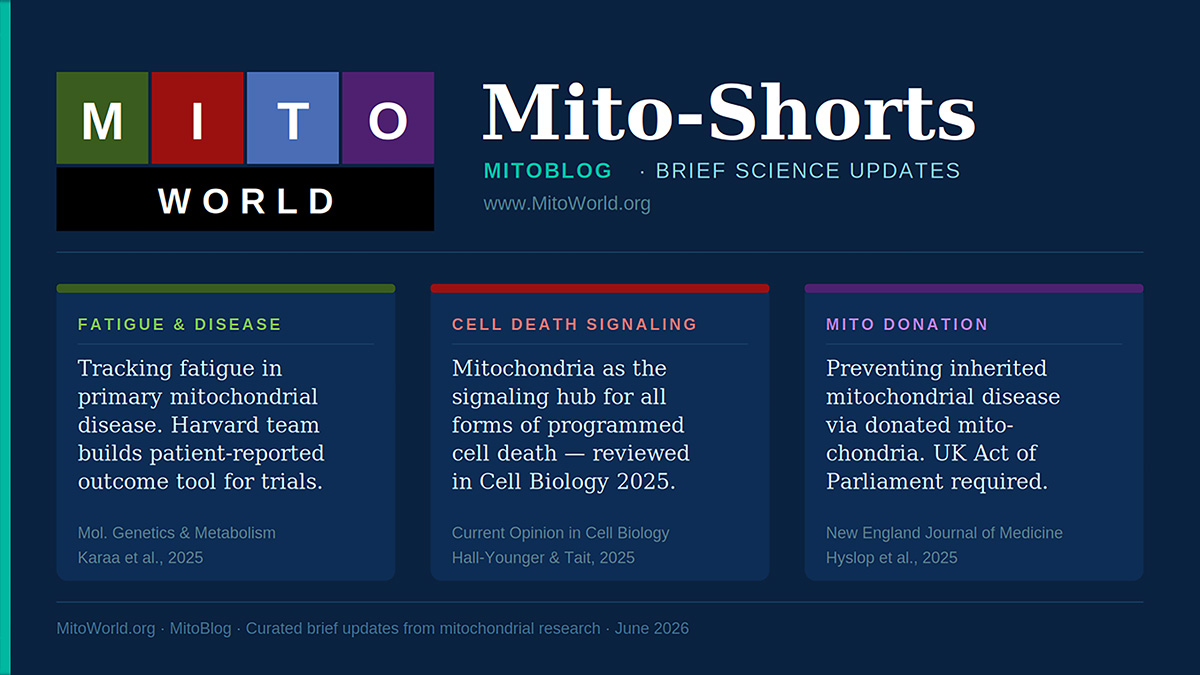
Mito-Shorts highlights interesting papers that have advanced our understanding of mitochondrial biology and disease. The group here includes descriptions of a clinical survey that helps to determine how fatigue affects those with mitochondrial diseases, mitochondrial control of apoptosis, and mitochondrial donation to prevent mitochondrial diseases in embryos.
Mito-Shorts
Fatigue and Primary Mitochondrial Disease
Mitochondria have long been associated with the production of cellular energy. Thus, it is not surprising that patients with primary mitochondrial disease experience debilitating fatigue. In a paper in Molecular Genetics and Metabolism, a multi-institute research team led by Amel Karaa at Harvard Medical School studied the relationship between primary mitochondrial disease and fatigue. They developed a brief report that patients can use to track their disease and improve treatments in clinical trials. Thus, this tool can make future trials more rigorous and relevant to the people they aim to help.
Clifford S, Stefanetti RJ, Bahar R, Hansson MJ, Gorman GS, Karaa A (2025) Qualitative study of fatigue in adults with primary mitochondrial disease: Development of the PROMIS Fatigue Mitochondrial Disease Short Form. Molecular Genetics and Metabolism 145(4): 109153.
Mitochondria and Cell Death Signaling
Mitochondria are well known for their role in energy production, but they are so much more. In an excellent recent review in Current Opinion in Cell Biology, Ella Hall-Younger and Stephen WG Tait describe the state of research into the involvement of mitochondria in apoptotic signaling. Mitochondria are a sort of signaling hub for the many types of programmed cell death. With only a few genes, mitochondria have assumed many roles, and one of the most critical is programmed cell death. This review is an excellent summary of the current state of knowledge of those issues.
Hall-Younger E, Tait SW (2025) Mitochondria and cell death signaling. Current Opinion in Cell Biology 94: 102510.
Preventing Mitochondrial Diseases with Donated Mitochondria
A multi-institute research team developed a procedure to prevent mitochondrial disease in fetuses by using donated mitochondria. The team was led by Doug McFarlane and Louise A. Hyslop. Preimplantation genetic testing can identify embryos with low levels of variants. In mitochondrial donation, microsurgery is used to transplant the nuclear genome from an egg of a woman with the mtDNA variant to an enucleated egg from an unaffected woman. Permission to use this procedure required an act of Parliament in the United Kingdom. Still, this is a solid breakthrough for women who want to reduce the risk of passing on mitochondrial diseases to their offspring.
Hyslop LA, Blakely EL, Aushev M, Marley J, Takeda Y, Pyle A, Moody E, Feeney C, Dutton J, Shaw C, Smith SJ (2025) Mitochondrial donation and preimplantation genetic testing for mtDNA disease. New England Journal of Medicine 393: 438-449.