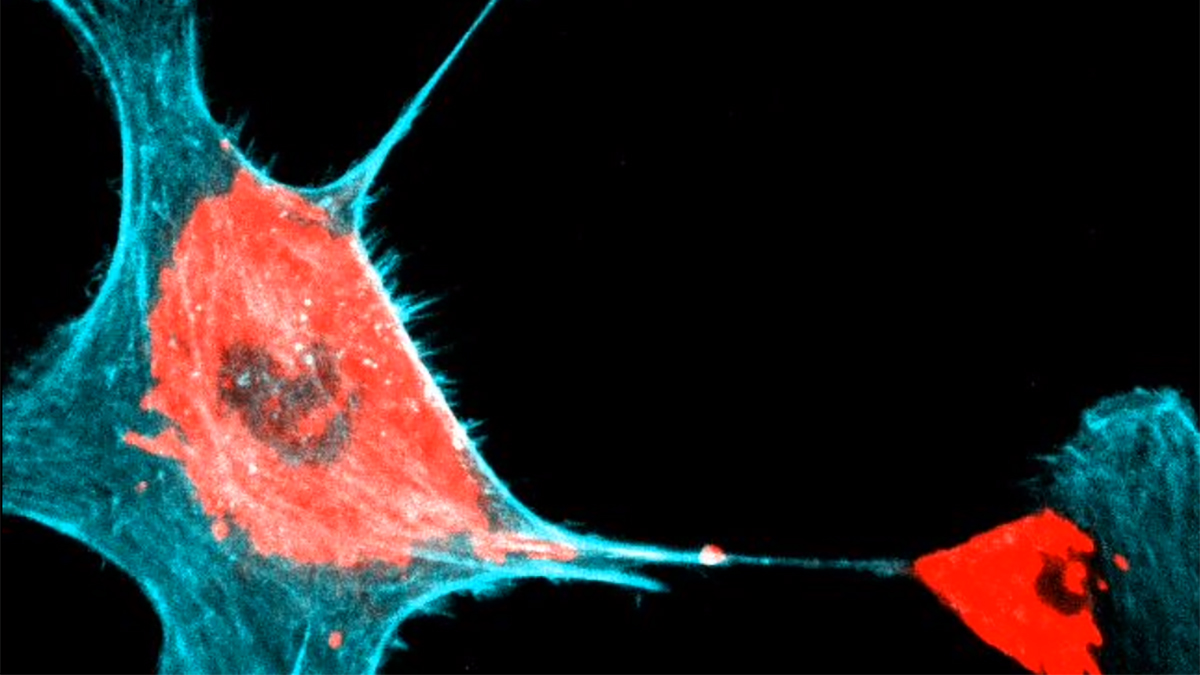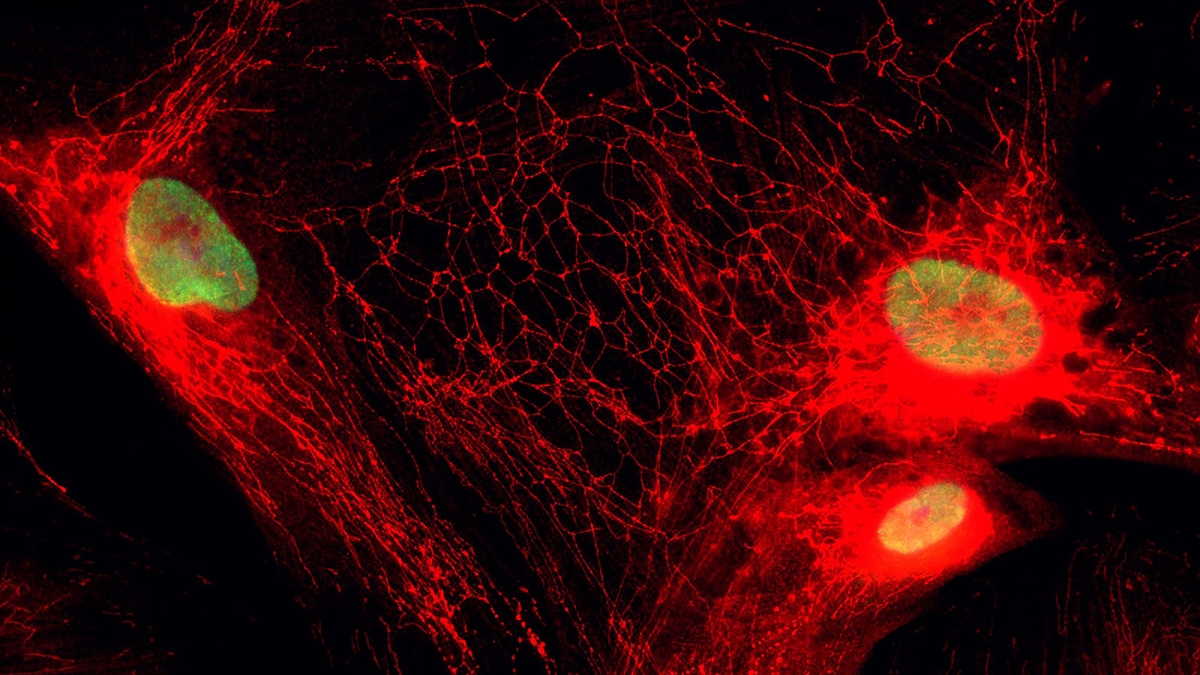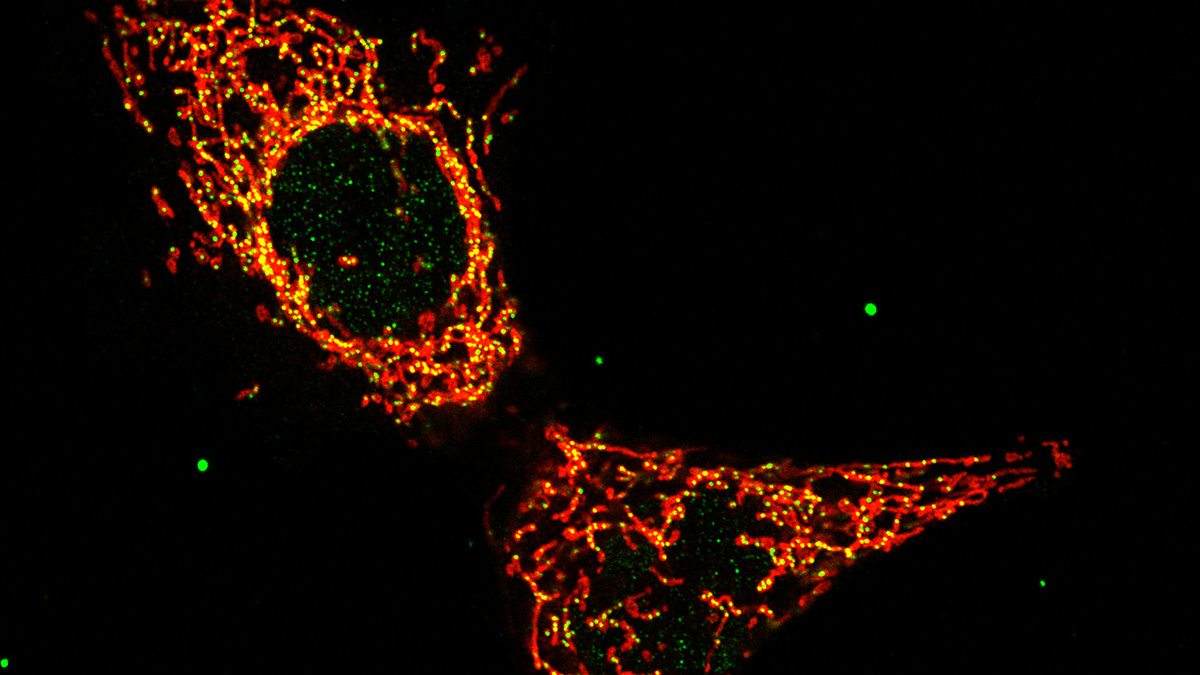
Image of two HCT116 cells (human colorectal carcinoma cell line) treated with 5FU. Red is mitochondria (anti-TOM20); Green is mtDNA (anti-DNA).
Mitochondria Determine Chemotherapy Sensitivity in Colorectal Cancer
Chemotherapy resistance accounts for more than 80% of cancer deaths, and so, preventing its development is a significant challenge in cancer treatment. Resistance comes from multiple sources. Some are related to the cancer cells themselves, and others are in reaction to the therapy. New ways to prevent the development of resistance are urgently needed to improve patient outcomes.
Recently, a multi-institute research team, led by Emma M. Kerr of Queen’s University Belfast, sought to better understand the cellular mechanisms related to resistance. To do this, they studied the cellular effects of chemotherapy in colorectal cancer. Their findings were published in a paper in Nature Metabolism.
To promote tumor progression, cancer cells reprogram cell energetics. Thus, the Kerr team chose to examine therapy resistance in colorectal cancer. They wanted to determine how mitochondria facilitate the acute stress response to 5-fluorouracil (5FU) in cells that survived treatment. That cancer is commonly treated with 5FU, but the effects are not fully understood. 5FU causes great metabolic stress to cells, and so, the research team examined its effects on mitochondria because of their deep involvement in cell metabolism.
Their results show that 5FU has multiple effects on mitochondria. Specifically, 5FU promotes mitochondrial adaptation at multiple levels. It changes the number, the communication and the activity of mitochondria, all of which mean that the cell can survive the metabolic stress caused by the drug. It does not inhibit complex I, it increases it’s activity, and the activity of the mitohcondria, and cell metabolism in general to delay tumor growth and prolong cell survival in preclinical models. They also found that oxidative metabolism signatures might predict the response to 5FU therapy.
This study enhances our understanding of how resistance to 5FU is driven by a coordinated mitochondrial response, but this can be blocked to deepen responses to 5FU. The increase mitochondrial activity was key to the ability of cancer cells to survive treatment with 5FU. Importantly, the findings suggest that this therapy can be used as part of combination therapy for colorectal cancer.
A Statement of Significance by Dr. Kerr.
Our work establishes mitochondrial plasticity as a central mechanism of acute chemotherapy tolerance in colorectal cancer. We show that, in response to 5FU-induced metabolic stress, cancer cells increase mitochondrial biogenesis, organisiation and respiratory activity to restore pyrimidine balance. This adaptation reveals a previously unrecognised mechanism of treatment tolerance and creates a targetable vulnerability that could inform patient stratification and rational combination therapies.
A Conversation with Dr. Kerr and Dr. Shaw
MitoWorld: Can you give us an idea of the direction your research might take to further your findings in the current paper?
EK: Our next step is to investigate how mitochondrial, and more broadly metabolic, plasticity influence treatment response and resistance in metastatic colorectal cancer. We are particularly interested in how the distinct environments of different metastatic sites reshape tumour metabolism, alter mitochondrial adaptation and ultimately determine sensitivity to 5FU-based therapy.
AS: From a fundamental biology standpoint, I’m particularly keen to map the precise molecular pathways that bring about the acute burst in mitochondrial biogenesis and structural reorganization that we observe. Chemotherapy-induced metabolic disruption acts as a powerful stress test. By studying how mtDNA copy number, organelle turnover, and quality control mechanisms are regulated during acute 5FU survival, we can uncover basic principles of mitochondrial plasticity that dictate how mammalian cells endure severe metabolic insults.
MitoWorld: Do you think the increased need for mitochondrial activity is related to the need for more energy production or is there a more complex mechanism at work?
EK: We think the mechanism is more complex than simply producing additional energy. 5FU disrupts pyrimidine balance, and our data indicate that surviving cancer cells increase mitochondrial activity to support UCK2-dependent uridine salvage and the restoration of nucleotide pools. Because this process involves several ATP-dependent phosphorylation steps, increased mitochondrial capacity may help sustain the response. However, mitochondria are likely supporting a broader metabolic programme, rather than acting solely as a source of ATP.
AS: I completely agree that it goes far beyond ATP generation. Mitochondria are fundamental metabolic integrators. When 5FU disrupts pyrimidine synthesis, mitochondria respond not just by ramping up bioenergetics, but by dynamically rewiring metabolic fluxes to feed nucleotide recovery and maintain redox balance. It highlights that mitochondria act as dynamic homeostatic sensors, they adapt their structure and function under extreme environmental stress to prioritize critical cellular salvage pathways over baseline energy production.
MitoWorld: This research has clear clinical implications. You note several in the Discussion. Do you plan to follow up with some of these?
EK: Yes. Our immediate priority is to translate these findings towards clinical testing by evaluating drugs that can disrupt the mitochondrial adaptations induced by 5FU. This could include repurposing existing medicines, as well as testing newer metabolism-targeted agents in combination with chemotherapy. In parallel, we want to refine mitochondrial activity signatures as biomarkers, so that future trials can focus on patients whose tumours are most likely to benefit from these combinations.
AS: Yes, and what excites me about the translational side is that targeting these adaptive mechanisms relies on dissecting fundamental mitochondrial biology. By understanding the specific mechanisms of mitochondrial biogenesis and respiratory reliance that surviving cells depend on, we can identify and exploit precise metabolic vulnerabilities in patients.
MitoWorld: Your work here was specific to colorectal cancer and 5FU. Can you speculate on whether your findings might have applications for other cancers? For example, 5FU is also commonly used to treat actinic keratosis and superficial basal cell carcinomas.
EK: Although our study focused on colorectal cancer and 5FU, the mechanism we identified appears to be linked more broadly to thymidylate synthase inhibition and the resulting pyrimidine stress, rather than to colorectal cancer alone. More than five million patients each year receive thymidylate synthase–targeting treatments, including fluoropyrimidines across gastrointestinal and other cancers, and antifolates such as pemetrexed in lung cancer. In our study, several TS-targeting drugs triggered similar mitochondrial adaptation across different cancer models, including lung cancer cells, suggesting that mitochondrial plasticity may be a wider mechanism of treatment tolerance. It is therefore also plausible that related responses could occur in conditions treated with topical 5FU, such as actinic keratosis or superficial basal cell carcinoma, although the route of drug delivery and tissue environment are very different and would need to be studied directly.
AS: It’s a fascinating prospect. Mitochondria possess a core, conserved toolkit for responding to extreme physiological pressure. Whether a cell is an exercising muscle fiber adjusting to oxygen debt, a neuron undergoing mitochondrial quality control under neurodegenerative stress, or a cancer cell enduring high-dose antimetabolite therapy, the underlying rules of mitochondrial adaptation are widely conserved! Whether these findings translate to other cancers in the context TS targeting therapies is an exciting area of future discovery for sure!
MitoWorld: Mitochondria are such deceptively simple organelles with an extraordinary range of activities. Can you comment on how they have evolved to be so critical in so many diseases?
EK: Mitochondria are involved in so many of the processes that shape how a cell behaves that it is not surprising they are linked to such a wide range of diseases. They do far more than generate energy, helping to coordinate metabolism, redox balance, signalling, immunity and the decisions that determine whether a cell survives or dies.
What makes mitochondria especially interesting is how adaptable they are. In cancer, tumour cells can take advantage of that flexibility to keep growing, cope with difficult environments and survive treatment. In other diseases, when those same mitochondrial processes go wrong, they can contribute to inflammation, degeneration or metabolic dysfunction. Their importance comes from the fact that mitochondria do not just support what a cell is doing; they help determine how that cell behaves.
That is why it is so important that we continue to study mitochondria in the right biological context. Advances in imaging, metabolic profiling and single-cell technologies are only now allowing us to appreciate how dynamic and context-dependent their roles really are. At the same time, disease-specific models, like genetically engineered mouse models used for CRC, let us examine mitochondrial behaviour within complex tumours that retain their surrounding tissue and immune environment. The more closely we study mitochondria in these realistic settings, the clearer it becomes that they are not simply affected by disease – they can actively shape how disease develops, progresses and responds to treatment.
AS: Their central role in disease stems directly from their evolutionary origin as endosymbionts and their function as primary metabolic and signaling integrators. Rather than serving merely as static ‘powerhouses,’ mitochondria evolved to sense physiological cues and coordinate crucial cell fate decisions as Emma mentioned. Given such broad control over cellular survival, their widespread involvement across disease indications is entirely expected.”
MitoWorld: How did you come to be interested in the involvement of mitochondria in cancer?
EK: My interest in mitochondria grew from a broader question: how do cancer cells survive extreme stress, and can we use that to expose new therapeutic weaknesses?
During my PhD, I studied how to increase cancer cell death, both through mitochondrial dependent, and independent, apoptosis. In my postdoctoral work I then explored the other side of that biology: how cells survive very high levels of KRAS-driven stress. We found that cells with the highest KRAS activity had fundamentally reprogrammed their mitochondria.
This context specificity really shaped the direction of my own lab. Mitochondria have this Janus-like role in controlling both life and death, and both sides create vulnerabilities we can exploit. Our current work asks how mitochondrial plasticity supports treatment tolerance and how we can turn that adaptation against the tumour.
AS: My interest in mitochondria stems from my early background in muscle biology and exercise physiology, where I became fascinated by how dynamically these organelles adjust to metabolic demand. When searching for PhD opportunities, I was struck by how many distinct human pathologies, from neurodegeneration to metabolic disorders,trace back to mitochondrial dysfunction. My PhD focused on unravelling a critical mitochondrial quality control pathway dysregulated in Parkinson’s disease, but my postdoctoral research shifted toward oncology, examining mitochondrial DNA copy number regulation in cancer.
What continues to stimulate my curiosity is a desire to understand the fundamental, basic biology of mitochondria more broadly, rather than viewing them strictly through the lens of a single disease. However, extreme pathological states, such as a cancer cell enduring high-dose chemotherapy stress, provide an unparalleled experimental window. They push mitochondrial plasticity to the limit, allowing us to uncover core mechanisms of organelle dynamics and stress tolerance that might otherwise remain hidden in homeostatic tissue.
Reference
Moss DY, Brown CN, Shaw AM, … Kerr EM (2026) Mitochondrial metabolism determines chemotherapy sensitivity in colorectal cancer. Nat Metab.