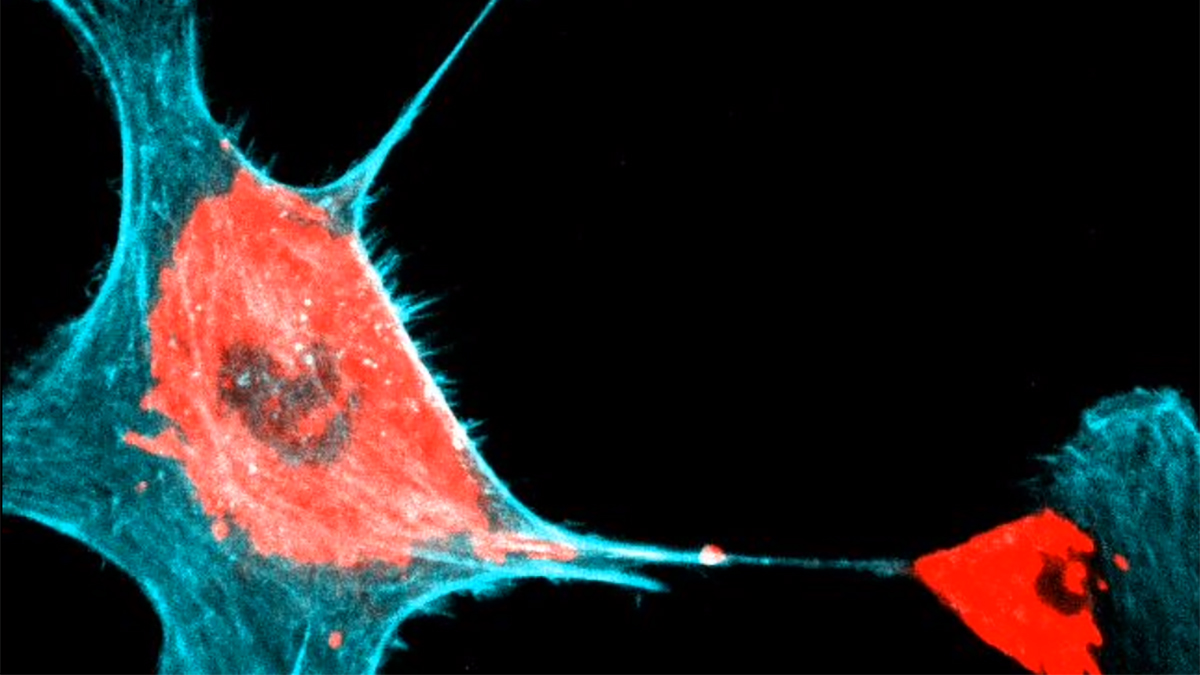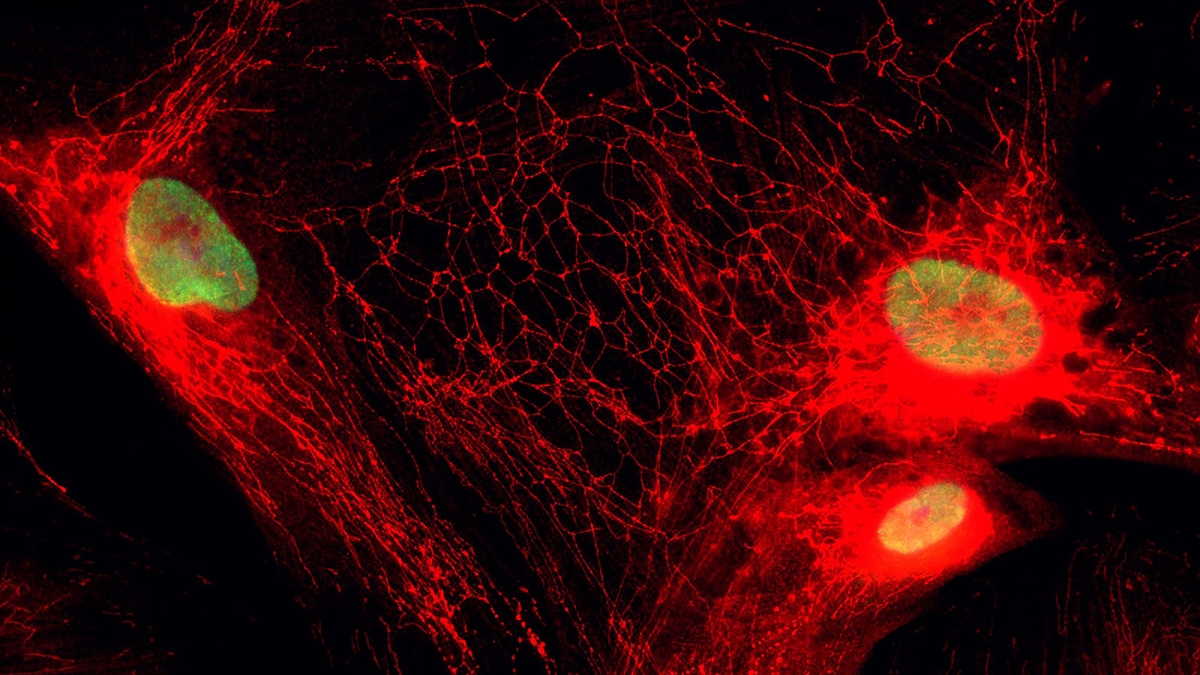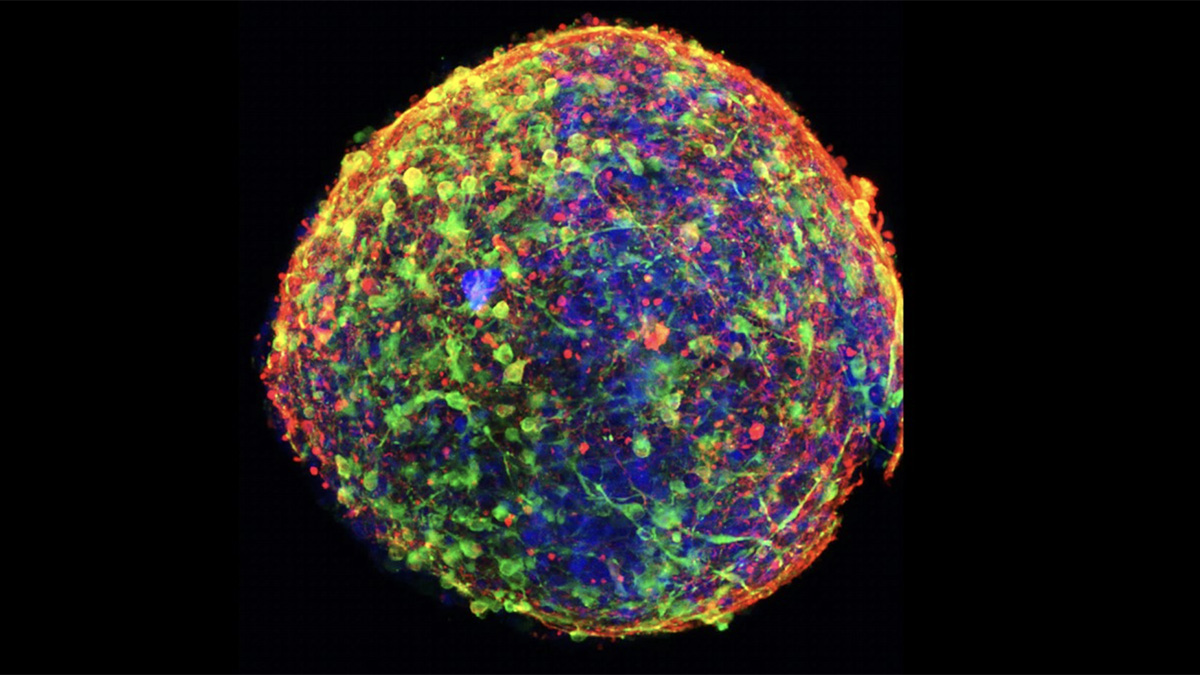
Mibrain organoid models of Leigh syndrome contained reduced amount of dopaminergic neurons (green). Deep learning screening identified repurposable drugs that corrected this defect.
Repurposing Drugs to Treat Leigh Syndrome
Leigh syndrome (LS) is an untreatable mitochondrial disorder that leads to psychomotor regression and early death. Recently, an international research team, led by Antonio Del Sol and Alessandro Prigione, screened approved drugs to find those that could be repurposed to treat LS. They identified two strong candidates that validate the screen and that might point to therapies for LS. The findings were published in Nature Communications.
Repurposing approved drugs is an efficient method for developing new therapies, especially in the context of rare diseases. Those drugs have already been shown to be safe for use in humans. The Del Sol-Prigione team took advantage of this strategy and previous findings that implicated the SURF1 gene variants in LS. They used a brain organoid model of LS that contained SURF1 variants. The atypical progenitor organization of the organoids suggested defective neuronal morphogenesis, and the LS iPSC-derived dopaminergic neurons also showed improper features.
Using the organoids, they developed a deep learning algorithm for cell type-specific drug repurposing screening. In parallel, they used a survival screen in a yeast model of LS. Two drugs stood out in the tests. Talarozole and sertaconazole rescued neuronal morphogenesis, reduced lactate release, and improved growth in the midbrain organoids.
The results validate the use of in silico screens with human brain organoids for finding new therapies for LS and potentially other mitochondrial diseases. They also give new hope for patients with this tragic disease. This paper also complements another recent study by Dr. Prigione that was published in Cell.
Statement of Significance from Dr. Prigione
Identifying new treatment options is crucial for an incurable disease, such as LS. Here we took advantage of so-called New Approach Methodologies (NAMs), including human organoids and artificial intelligence (AI), and discovered two drugs that may be used for treating individuals with LS. This powerful platform can now be employed also in the context of other rare neurodevelopmental diseases.
A Conversation with Dr. Prigione:
MitoWorld: Can you give us an idea of the directions you might take to extend these findings?
Dr. Prigione: We are following these results on two different paths. First, we are exploring ways to bring these treatments to LS individuals. In particular, we are focusing on talarozole since it showed stronger effects in the models and has already been tested in humans as oral formulation in a trial that was conducted last year for osteoarthritis. Unfortunately, the company that developed the oral formulation for the trial did not agree to provide the drug for us. Therefore, we are looking into alternative options, including manufacturing the compound ourselves.
The second path is back to research. We are going to assess the effect of these two compounds in other LS models both humans and animals and determine their potential synergy with other drugs that we have identified, such as sildenafil (see Zink et al., Cell 2026). We are also further developing the deep learning and AI strategy to extend the computational screen to additional brain organoid models to possibly identify additional repurposable candidates and better understand the underlying mechanisms of actions in this disease context.
MitoWorld: In this paper, you focused on brain organoids. Might your overall strategy be useful with other tissues?
Dr. Prigione: Yes, combining AI and organoid models may represent a powerful approach to take advantage of NAMs and possibly reduce the reliance on animal models, especially for those disease conditions for which animal models are not available. For example, SURF1 variants cause a severe form of LS but mice without Surf1 do not show defects and even live longer than healthy animals. Therefore, human iPS models may represent an important strategy to advance drug discovery for these gene defects.
MitoWorld: You identified two potential drugs for LS. Do you plan to pursue any clinical studies to advance those treatments?
Dr. Prigione: As mentioned above, we are very much interested in exploring ways to assess these drugs (and particularly talarozole) in clinical settings. For this, we are partnering with the patient organization Cure Mito. Together, we are considering manufacturing the drug ourselves to develop an ethical path that would follow us determining the potential effectiveness of talarozole in LS individuals.
MitoWorld: You have a great strategy for repurposing drugs. On the other hand, those drugs also provide information about the disease process itself. You describe some of those implications in your Discussion.
Dr. Prigione: Yes, we speculate that drug function may be important for two aspects beyond energetics. First, they may act on retinoic acid pathway to improve neuronal development. Second, they may act on PPARγ, which may impact inflammation and was previously implicated in the positive effects seen in LS mice treated with cannabidiol (CBD). These results highlight the complexity of the disease processes and suggest that combinatorial treatment strategies might also be considered to combat both neurodevelopmental and neuroinflammatory components.
MitoWorld: We are always interested in what first interested you in mitochondria.
Dr. Prigione: During my PhD, I worked in the lab of Gino Cortopassi at UC Davis and started working on mitochondrial DNA deletions in human cellular models. That project and that experience were essential for me, as I was struck by the complexity and essentiality of mitochondria. During my postdoc, I changed the field and worked on iPS cells. Therefore, when I started my independent laboratory, I decided to combine these two topics and began using iPS models to study mitochondria-related diseases.
References
Menacho C, Okawa S, Álvarez-Merz I, Wittich A, Muñoz-Oreja M, Lisowski P, Martín ML, Pentimalli TM, Zakin S, Thevandavakkam M, Jerred C, … Del Sol A, Prigione A (2026) Accelerating Leigh syndrome drug discovery through deep learning screening in brain organoids. Nature Communications 17(1): 3570.
https://www.nature.com/articles/s41467-026-71391-2
Zink A, Dai DF, Wittich A, Henke MT, Pedrotti G, Heiduschka S, Santamaria G, Pentimalli TM, Brueser C, Notopoulou S, Umar AR, … Prigioni A (2026) Pluripotent stem-cell-based screening uncovers sildenafil as a mitochondrial disease therapy. Cell 189: 1656–1679.