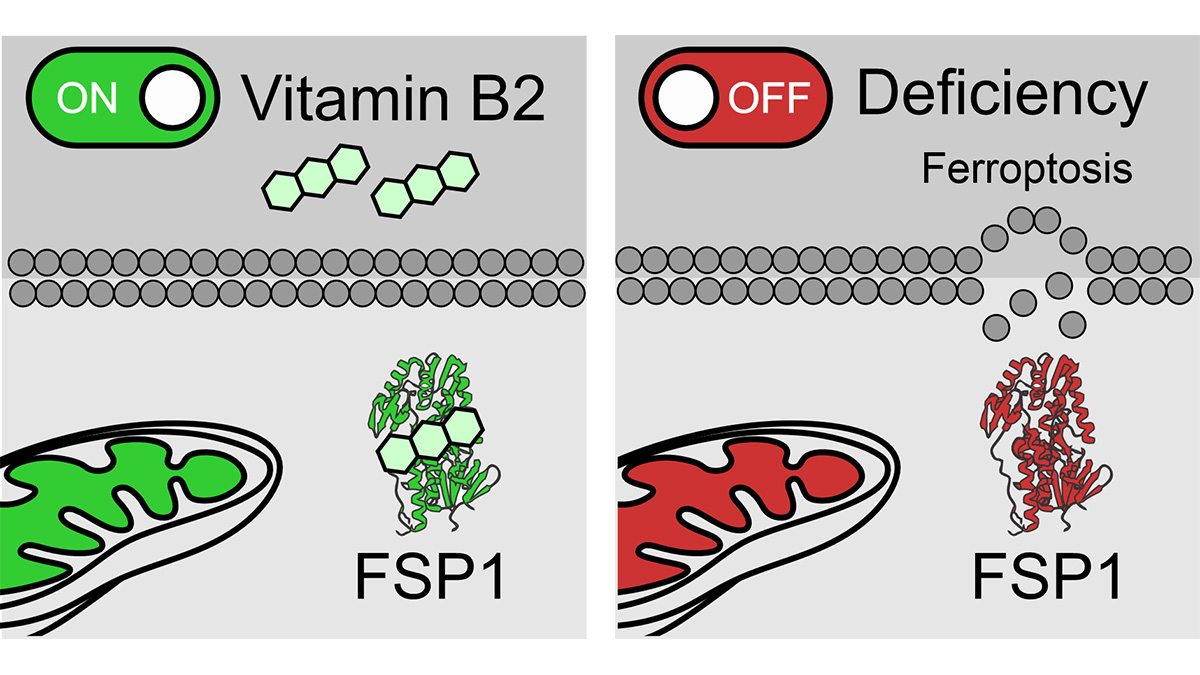
In a recent paper in Nature Cell Biology, Vera Skafar, member of a research team led by Prof. José Pedro Friedmann Angeli at the Rudolf-Virchow-Zentrum (University of Würzburg), examined the activity of ferroptosis suppressor protein 1 (FSP1) in protecting against phospholipid peroxidation and ferroptosis. They discovered that riboflavin (also known as vitamin B2) is a critical mediator for stabilizing FSP1 and suggest that riboflavin metabolism represents an intriguing possible therapeutic strategy.
Riboflavin Modulates Lipid Peroxidation and Ferroptosis
A multi-institute research team, led by Prof. José Pedro Friedmann Angeli, examined the activity of ferroptosis suppressor protein 1 (FSP1) in protecting against phospholipid peroxidation and ferroptosis. They discovered that riboflavin is a critical mediator for stabilizing FSP1 and suggest riboflavin metabolism as an intriguing possible therapeutic strategy. The findings were published in a recent paper in the journal Nature Cell Biology.
Membranes are critical elements of all cells, but they can be damaged by oxidation. Damaged membranes can activate the programmed cell death mechanism known as ferroptosis. Ferroptosis is carefully regulated, and one of the key regulators of that process is the protein FSP1. Membrane damage and ferroptosis are often observed in cancer, neurodegenerative diseases, and ischemia-reperfusion injuries.
Prompted by this information, the Friedmann Angeli team sought to identify factors that regulate FSP1 function. They used a CRISPR-Cas9 screen to find such factors. Interestingly, the screen discovered that riboflavin has a role in maintaining the stability of FSP1 and, thus, modulates membrane phospholipid peroxidation and ferroptosis. In addition, they found that roseoflavin, an antimetabolite of riboflavin, interferes with FSP1 function and, thus renders cancer cells susceptible to ferroptosis.
These findings increase our understanding of how membranes are maintained and also have intriguing clinical implications. Using riboflavin to modulate FSP1 activity might provide therapeutic strategies for treating cancers and neurodegenerative diseases.
Statement of Significance: Vera Skafar
Riboflavin is an essential nutrient obtained from the diet and converted inside cells into molecules that support numerous metabolic reactions, including those that protect against oxidative damage. We found that riboflavin deficiency makes cancer cells highly susceptible to ferroptosis by compromising the FSP1 protective axis. Our findings uncover a link between a common nutrient and a key survival mechanism in cancer cells, offering a new strategy to trigger ferroptosis and potentially enhance anticancer therapies. The paper shows that interfering with metabolization of riboflavin (for example, using antimetabolites, such as riboflavin) can sensitize cancer cells to ferroptosis, revealing a metabolic vulnerability. Importantly, these observations have been validated across multiple cancer cellular models, including high-FSP1-expressing melanoma, breast and lung cancer cell lines. Beyond cancer, this mechanism is also relevant to diseases involving oxidative stress and ferroptosis, including neurodegenerative disorders and ischemia-reperfusion injury.
A Conversation with Vera Skafar:
MitoWorld: This is an interesting finding. Could you indicate what the next steps in your research might be?
Vera Skafar: Building on the molecular mechanisms established in this study, we’re now moving toward the translational edge of our research to explore the therapeutic potential of these insights. We’re focused on identifying and developing small-molecule inhibitors of riboflavin metabolism and assessing whether they can induce ferroptosis in preclinical cancer models.
MitoWorld: Riboflavin-derived metabolites are important in mitochondrial function, which is implicated in cancer and neurodegenerative diseases. Can you describe how your findings with riboflavin and FSP1 might be relevant to mitochondria health?
Vera Skafar: We believe our findings are relevant to the MitoWorld community because riboflavin metabolism strongly influences mitochondrial function. Under deficiency, we observe a clear downregulation of mitochondrial activity. This is especially interesting in the context of cancer, where increased mitochondrial function has been linked to therapy resistance and the ability of tumors to adapt to stressful environments, such as acidic conditions. In that sense, interfering with these pathways could represent a strategy to limit mitochondrial-driven resistance mechanisms and potentially improve existing cancer therapies.
MitoWorld: Interestingly, you note the importance of selenium, as well as riboflavin, to modulation of ferroptosis and suggest that micronutrients are critical to the health of membranes. Are you looking for other factors that influence membranes?
Vera Skafar: Absolutely. What’s becoming clear is that membrane health depends on a network of metabolic inputs. Selenium supports GPX4, riboflavin supports FSP1, and together they form complementary defense systems. We’re now looking more broadly at other vitamins, cofactors, and lipid metabolic pathways that might influence ferroptosis sensitivity. It’s an exciting area connecting nutrition, metabolism, and cell death.
MitoWorld: The results with riboflavin are interesting. Can you see that as part of a therapy?
Vera Skafar: The FSP1 protective axis is important for certain cancers, such as lung adenocarcinoma, and riboflavin metabolism has been reported to represent a metabolic dependency in hematological malignancies (myeloid and lymphoid), as well as in pancreatic ductal adenocarcinoma. Targeting the metabolization of riboflavin could therefore open new treatment opportunities, especially in combination with existing targeted therapies, where we’re seeing a synergic effect. Importantly, emerging evidence suggests there could be a therapeutic window where cancer cells are vulnerable, but healthy tissues are largely unaffected, making this approach particularly promising.
MitoWorld: Riboflavin is a common vitamin. Can you imagine ways that it might be harnessed to treat the diseases involving membrane damage and ferroptosis?
Vera Skafar: It really depends on the disease context. In conditions such as neurodegeneration, supporting riboflavin-dependent pathways could help protect membranes from oxidative damage. However, in cancer those same pathways can help malignant cells survive, so inhibiting riboflavin metabolism might be beneficial. Our findings may also help explain why riboflavin supplementation studies in cancer have shown inconsistent results, highlighting the need for caution when boosting these pathways.
Reference
Skafar V, de Souza I, Ghosh B, Ferreira dos Santos A, Porto Freitas F, Chen Z, Sun S, Donate Castillo M, Nepachalovich P, Seufert L, Bothe S, et al. (2026) Riboflavin metabolism shapes FSP1-driven ferroptosis resistance. Nature Cell Biology 13: 1-1. doi: 10.1038/s41556-025-01856-x