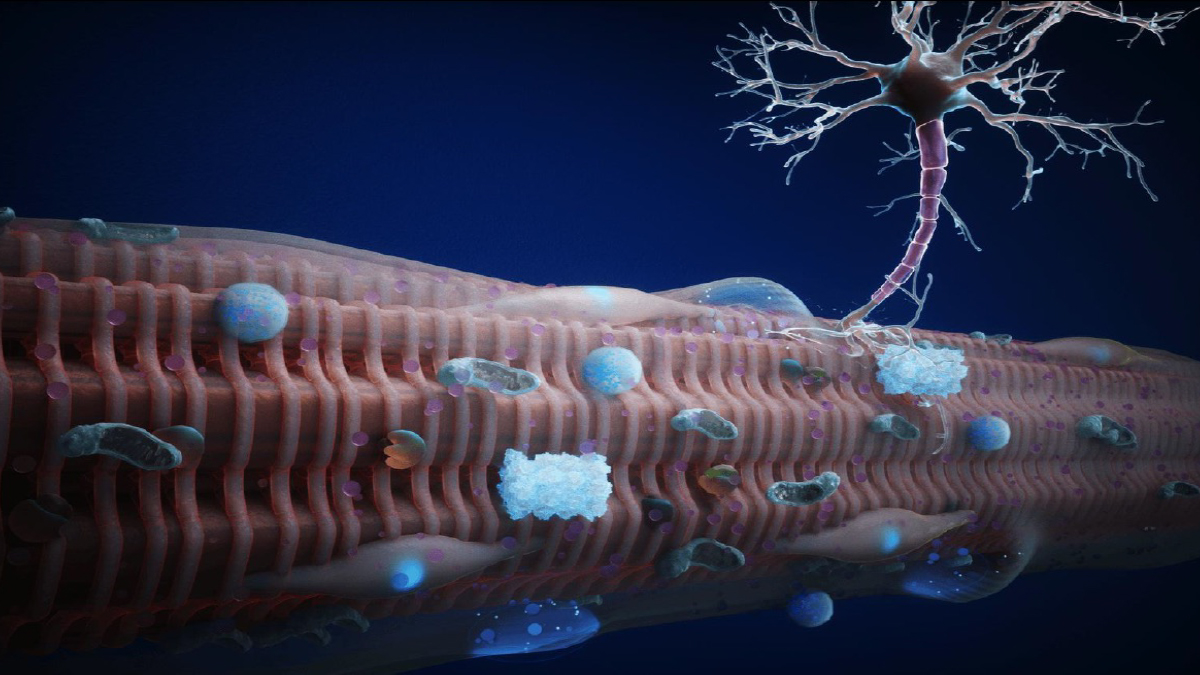
Illustration by Ella Maru Studio. A stylized motor neuron and muscle fiber highlighting mitochondria and the cellular machinery involved in muscle function, maintenance, and repair.
Hallmarks of Skeletal Muscle Health
The health of skeletal muscle is critical to overall wellbeing. While the loss of muscle mass and force is associated with aging, shortened life span and multiple chronic diseases, physical activity, which is thought to improve overall muscle health, is widely viewed as important for health and quality of life. Despite the significance of skeletal muscle to health, until now, no coherent model has sought to conceptually integrate the various aspects of muscle homeostasis.
Recently, a group of international scientists, led by Marco Sandri (University of Padova) and Anna Vainshtein (Craft Science), proposed a unifying framework that spans metabolism and bioenergetics, proteostasis, genomics, excitability, structure, regeneration and crosstalk. They hope that this framework will facilitate the development of new diagnostics and therapeutics. The consensus was published in Nature Metabolism.
The authors note that this framework and its hallmarks should enable researchers and clinicians to develop effective strategies for muscle-related disorders. They believe it is particularly timely with the popularity of GLP-1 receptor agonists and other treatments that promote weight loss as their effects on overall muscle mass and function are of great interest.
Not surprisingly, mitochondria figure into several of the hallmarks. Metabolism and bioenergetics obviously involve mitochondria, but these organelles also have significant functions related to other hallmarks. Mitochondria play a major role in proteostasis and are specifically important in programmed cell death and autophagy. Autophagy is also vital for excitability at the neuromuscular junction while ATP production is important for muscle structure. All of the hallmarks are further integrated in multiple ways.
The framework describes mechanisms and measures for each of the seven hallmarks and demonstrates how they can be integrated to facilitate the development of diagnostics and therapeutics. It promises to be as valuable to the health of muscle tissue as similar frameworks have been for cancer and aging.
A Statement of Significance by Dr. Sandri.
Skeletal muscle biology has traditionally been largely siloed, with advances in various aspects occurring in parallel but largely separately. The field has lacked a holistic view in which a shared conceptual framework to explain how these process act together to keep muscle healthy and how their failure produces muscle loss observed with aging or disease. That has made it challenging to identify efficient diagnostics and therapeutic interventions.
The Hallmarks of Skeletal Muscle Health proposes that structure. It describes seven interdependent properties: metabolism and bioenergetics, proteostasis, genomics, excitability, structure, regeneration and crosstalk, that together govern muscle integrity, adaptability and resilience.
The significance is not in naming these processes, most of which are well recognized, but in framing them as an integrated system in which perturbation in one hallmark propagates across the others. Each hallmark is defined mechanistically, and we propose ways to measure and modify it which takes the framework from theoretical toward real-world application. Our hope is that it resonates with the muscle research community and beyond. Encouraging those in and outside the field to evaluate muscle health in a more holistic and comprehensive way. We also hope this can help illuminate knowledge gaps for future research and provide a roadmap for the development of better knowledge, diagnostics and treatments in skeletal muscle.
A Conversation with Dr. Sandri.
MitoWorld: It is early after publication, but can you say what has been the reaction of the scientific community to the framework so far?
Dr. Sandri: It is indeed still early, but I am cautiously optimistic. By looking at the altimetric score, the paper ranks 1st In Nat Met and among the 99th percentile of 202,818 tracked articles of similar age in all the journals. Therefore, the attention of scientists has been attracted by this publication. Most of the reactions I have seen so far have been overwhelmingly positive and very receptive. There is a genuine sense that the muscle field is due for this kind of attention, and colleagues seem pleased to see its biology organized into a coherent framework. I am happy to see people engaging with the framework actively and testing it against their own areas. That is most encouraging, because the value of the framework is in being used and tested.
MitoWorld: Can you speculate on what might be some of the early benefits of the use of the framework?
Dr. Sandri: I think the most immediate benefit is a common language and a shared map. At the experimental level, it encourages investigators to look beyond a single pathway or endpoint and consider whether an intervention changes several dimensions of muscle health.
The emphasis on measurability and modifiability was deliberately practical. Muscle mass is important, but an increase in mass does not necessarily mean proportional improvement in strength, metabolic competence or function. We have seen this experimentally and clinically. The framework encourages the use of mechanism-aligned biomarkers and multi-hallmark read-outs that may reveal dysfunction before substantial muscle loss has occurred.
We also hope this will help with clinical trial design. If we understand which hallmark a therapy is expected to modify, then biomarkers and endpoints can be selected to test that mechanism rather than relying only on relatively downstream measures. And for people entering the field, I think having an organizing structure through which to understand a very large body of literature is also valuable.
MitoWorld: Mitochondria have roles in so many key cell functions in addition to energy production. Can you comment on their importance?
Dr. Sandri: Mitochondria are central to muscle health and vitality. It is not simply a site of ATP production, though of course that role is essential in a tissue that must generate force over decades. Mitochondria are a hub that integrates energy production, calcium homeostasis and redox signaling, with gene regulation, excitability, proteostasis and regenerative competence.
Mitochondrial quality is maintained by a constant balance of fusion, fission and the selective removal of damaged organelles by mitophagy, and when that balance fails, dysfunctional mitochondria accumulate and contribute not only to muscle degeneration, weakness and fatigue but can reverberate locally and systemically by promoting the secretion of myokines. So, the organelle sits at the intersection of several hallmarks at once.
MitoWorld: Several of the hallmarks are also related to aging and cancer. Is there overlap between those earlier hallmarks and your muscle one?
Dr. Sandri: Yes, if you think about it, it makes complete sense for there to be overlap, after all the hallmarks that define aging also influence muscle health, such as proteostatic decline, mitochondrial dysfunction, genomic and epigenomic change, and altered intercellular communication, appear in the hallmarks of aging and in a tissue-specific form, in ours. But muscle has some peculiarities. It is a post-mitotic, protein-dense, force-generating tissue, and processes, such as excitability and the neuromuscular junction, sarcomeric structure, and satellite-cell-driven regeneration, are specific to it. So, I would describe the relationship as a shared foundation expressed through muscle-specific mechanisms.
MitoWorld: Can you describe some of your own research and how it relates to the hallmarks?
Dr. Sandri: Much of my work has been at the interface between proteostasis and mitochondrial biology and how mitochondria signal to the nucleus to promote adaptative responses. For many years, our laboratory has studied the signalling pathways that control muscle mass. Much of our work has focused on the systems that control proteins and organelles turnover, particularly the ubiquitin–proteasome and autophagy-lysosome. We were the first to show that these degradative systems are controlled by transcription factors and identified FOXOs as the master regulators. And despite our original hypotheses, we discovered that these pathways cannot be labeled as simply catabolic and therefore detrimental. FOXO activation can promote protein degradation and muscle atrophy, but basal autophagy is essential for muscle homeostasis. When autophagy is impaired in muscle, damaged proteins and organelles accumulate and the phenotype extends well beyond muscle mass, with mitochondrial abnormalities, sarcomere disruption, denervation and impaired regeneration.
The role of bioenergetics and mitochondrial quality became a natural extension of these questions. We have studied how the balance between fusion and fission regulates mitochondrial function and muscle mass, including the roles of fusion and fission proteins, such as OPA1 and DRP1, with balance playing a key role. Mitochondria must continuously remodel, and disrupting either side of this process has consequences for muscle metabolism and health that differs in terms of gene regulation, signaling pathways, calcium homeostasis, oxidative stress and muscle phenotype when the network is hyper-fragmented or hyper-fused. Our work has also shown that mitochondrial stress in skeletal muscle can travel beyond the fibre, generating signals with systemic metabolic effects.
For me, this illustrates the logic behind the Hallmarks framework. We often begin experimentally with one gene or one pathway because that is how we can establish causality. But a phenotype is typically more complex impacting multiple Hallamrks. A defect in autophagy impacts mitochondria, myofiber structure, contractile capcity and the neuromuscular junction. Moreover, mitochondrial dysfunction alters chromatin, promotes gene expression, disrupts proteostasis, metabolism and signalling, influencing muscle structure, regeneration and function. The framework is an attempt to connect these mechanistic observations into a more comprehensive view of muscle health.
Reference
Vainshtein A, Blaauw B, De Bock K, Munoz-Canoves P, Olson EN, Ottenheijm CA, Richter EA, Ruas JL, Schaffer L, Spiegelman B, Sandri M (2026) The hallmarks of skeletal muscle health. Nature Metabolism.