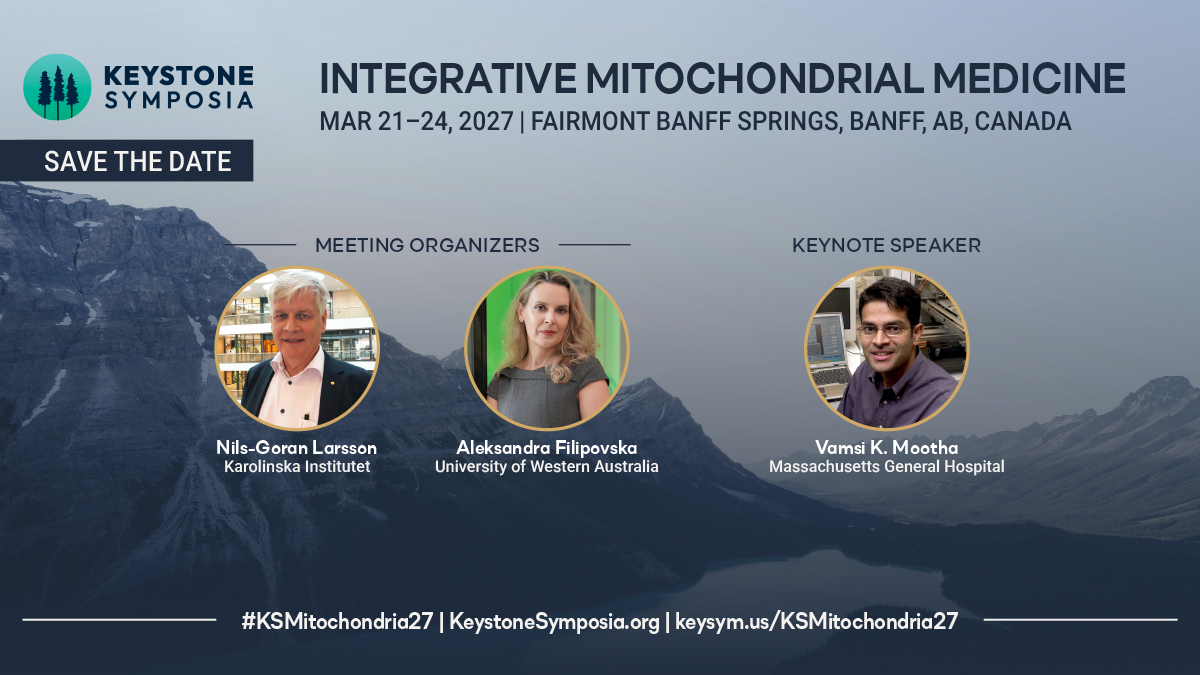
An unusual Keystone Symposium brings genome editing, synthetic biology, imaging, metabolic intervention, precision medicine, commercialization and mitochondrial transplantation under one roof. Keystone Symposium: Integrative Mitochondrial Medicine | March 21–24, 2027 | Banff, Alberta, Canada | Conference Program & Registration
Is “Integrative Mitochondrial Medicine” Becoming a Field? Keystone Meeting
An unusual Keystone Symposium brings genome editing, synthetic biology, imaging, metabolic intervention, precision medicine, commercialization and mitochondrial transplantation under one roof.
Keystone Symposium: Integrative Mitochondrial Medicine | March 21–24, 2027 | Banff, Alberta, Canada | Conference Program & Registration
Something interesting is happening around mitochondria.
For decades, mitochondrial research has necessarily been divided among specialties. Researchers studying mitochondrial DNA and gene expression attended one set of meetings. Bioenergetics and metabolism had another community. Mitochondrial disease clinicians had theirs. Synthetic biologists, computational scientists, bioengineers, cancer researchers and biotechnology investors generally operated in still other worlds.
A Keystone Symposium scheduled for March 21–24, 2027, in Banff, Canada, is trying something different.
Its title is Integrative Mitochondrial Medicine.
The name may prove more significant than it first appears. Is “integrative mitochondrial medicine” simply a useful description for an unusually broad scientific meeting—or are we seeing the early formation of a field that connects mitochondrial biology, engineering and clinical medicine?
That is one of the questions MitoWorld has put to scientific organizers Nils-Göran Larsson of Karolinska Institutet and Aleksandra Filipovska of the University of Western Australia.
From understanding mitochondria to intervening in them
The program itself helps explain why the question is worth asking.
The meeting begins with Vamsi Mootha discussing metabolic interventions for mitochondrial dysfunction and then moves directly into mitochondrial genome editing, with presentations on correcting pathogenic mtDNA mutations and creating gene-edited mitochondrial disease models.
That afternoon, the subject becomes mitochondrial synthetic biology: tools for manipulating organelle biogenesis, regulating metabolism and engineering mitochondria to alter energy-conversion efficiency.
The following sessions move through advanced mitochondrial imaging, precision medicine, metabolic networks, new technologies and, finally, mitochondrial transplantation and donation.
This is not simply a tour of mitochondrial biology. It puts several different ways of intervening in mitochondria into conversation with one another.
The distinction matters.
Mitochondrial medicine has historically faced an unusual technical problem. Mitochondria are central to metabolism, signaling and cellular function, but manipulating mitochondrial DNA has remained far more difficult than manipulating nuclear DNA. Many of the technologies that transformed molecular biology have therefore reached mitochondria slowly or incompletely.
That technological gap is now receiving serious attention.
The UK’s Advanced Research + Invention Agency (ARIA), for example, has committed £66 million to its Precision Mitochondria program, funding 19 teams working toward a toolkit for engineering the mitochondrial genome in vivo. The program divides the problem into four fundamental capabilities: getting nucleic acids into mitochondria, expressing engineered genetic material, maintaining it, and ultimately transferring or delivering engineered mitochondria or their toolkits in vivo.
The goal is not a single drug. It is to create capabilities that mitochondrial researchers largely have not had before.
That makes the timing of the Keystone meeting particularly interesting.
What is happening with new technologies?
The important development may not be any single technology. It may be their convergence.
Genome editing asks whether defective mitochondrial genomes can be selectively changed or corrected. Synthetic biology asks whether mitochondrial functions can be deliberately redesigned. Advanced imaging is allowing investigators to observe mitochondrial structure and behavior at increasingly fine scales inside cells and tissues.
Metabolomics and systems biology are providing ways to understand mitochondria as components of larger metabolic networks rather than isolated cellular power sources.
Mitochondrial transplantation and transfer is a very controversial topic that may raise another possibility entirely: whether functioning mitochondria themselves can become therapeutic agents or vehicles for intervention.
And precision medicine asks the difficult translational question: which intervention, for which mitochondrial defect, in which patient, and at what stage of disease?
Normally, these questions can live in separate scientific communities. In Banff they will occupy the same program.
That may be the most important experiment taking place at the conference.
Mitochondria meet biotechnology
There is another unusual feature.
Keystone has scheduled a “Shark Tank Pitch Session for Commercialization” with Pretzel Therapeutics’ Thomas Keating, University of Gothenburg mitochondrial researcher Claes Gustafsson, CodeBreakers’ Oliver Rackham and Precision BioSciences’ Wendy Shoop participating.
Moving mitochondrial discoveries into medicine will require more than publications. New delivery systems, editing platforms, engineered organelles, diagnostics and therapeutic approaches will have to move from laboratories into companies, clinical development and eventually patients.
MitoWorld saw evidence of this growing interest outside the traditional mitochondrial community earlier this year. At the 2026 SynBioBeta conference in California, MitoWorld helped organize a session on Mitochondrial Transplantation and Genome Editing: Engineering the Metabolic Engine of Complex Life. The session brought mitochondrial biology into a meeting populated by synthetic biologists, technology developers, entrepreneurs and investors.
ARIA’s Precision Mitochondria program was represented there as well.
The question for Banff is whether this exchange can work in the other direction: Can a mitochondrial science meeting draw engineers, technology developers, entrepreneurs and investors into mitochondrial medicine?
Is this a conference—or the beginning of something larger?
That leaves the question contained in the conference’s title: What is Integrative Mitochondrial Medicine?
It could simply mean bringing several branches of mitochondrial science together for four days. But there is another possibility.
The mitochondrial field may be reaching a point at which its traditional divisions no longer match the problems researchers are trying to solve.
Genome editing depends upon delivery. Delivery depends upon mitochondrial membranes and import mechanisms. Synthetic biology depends upon understanding mitochondrial gene expression. Therapeutics require biomarkers and patient stratification. Transplantation requires understanding mitochondrial quality, compatibility and persistence. Metabolic interventions require understanding the larger networks in which mitochondria operate.
Increasingly, the science connects.
If so, “integrative mitochondrial medicine” may describe not a particular therapy or discipline, but a way of organizing the problem: bringing mitochondrial biology, technology and medicine into a common framework.
Questions for the Organizers
We have asked Larsson and Filipovska where the idea came from, what they hope will happen when these communities meet, whether the model could continue beyond a single Keystone Symposium, how efforts such as ARIA’s Precision Mitochondria fit into this emerging landscape, and whether biotechnology and investment communities should become part of it.
MitoWorld questions for Nils and Aleksandra:
MitoWorld: Why Integrative Mitochondrial Medicine? Is this simply a conference title, or could it mark the beginning of a new field of medicine?
Larsson and Filipovska: It is more than a conference title, although I would describe it as an emerging framework rather than an established medical subspecialty. Mitochondrial research has often been divided among biochemistry, bioenergetics, genetics, metabolism, structural and cell biology, and clinical medicine. The technologies now becoming available – including genome editing, synthetic biology, advanced imaging and metabolic profiling – require those areas to work together. The meeting is intended to connect fundamental mitochondrial biology with engineering and clinical translation. Whether this develops into a distinct field will depend on whether the collaborations and shared approaches continue beyond the meeting.
MitoWorld: Where did the idea come from to bring multiple disciplines and technologies together in one conference? These communities usually meet separately, so how did the two of you decide on this approach?
Larsson and Filipovska: The idea grew from discussions about how mitochondrial research is organized and the way the important problems now need to be solved. We bring complementary perspectives, but we both saw that progress in mitochondrial medicine increasingly depends on connecting genome biology and gene expression with metabolism, imaging, engineering and patient-focused research. We built the program deliberately across those boundaries, so that each community would be exposed to the questions, methods and advantages of the others.
MitoWorld: The concept seems unusual in bringing together cell biologists, clinicians, computational modelers, bioengineers and representatives for the biotech industry. What do you hope the meeting will achieve, and could the idea continue through a formal organization?
Larsson and Filipovska: The most valuable outcome would be new collaborations and a shared language across fields that do not usually meet. We want discovery scientists to understand the clinical bottlenecks, clinicians to see what emerging technologies may make possible, and engineers and computational researchers to engage with the biological complexity of mitochondria. We are not using the meeting to launch a formal organization. We would like communities to come together organically and identify the questions that genuinely require an integrative approach. If there is sustained interest, that could support future meetings, working groups or other coordinated activities. The meeting will also have a separate session to critically discuss the controversial area of mitochondrial transplantation as a treatment.
MitoWorld: ARIA’s Precision Mitochondria program is at the forefront of treating mitochondria as a programmable platform. Do you expect its teams to participate, and will the meeting consider other efforts to overcome long-standing technological barriers in mitochondrial medicine?
Larsson and Filipovska: ARIA’s Precision Mitochondria program is an important example of the shift from describing mitochondrial dysfunction to building the tools needed to intervene. Several of the speakers are involved in projects funded by ARIA. We therefore expect the program and the work of its teams to be part of the discussion, but the meeting is deliberately broader than any one initiative. The sessions address several of the field’s persistent barriers, including mitochondrial delivery, genome manipulation, control of gene expression, metabolic reprogramming, imaging across scales and translation into therapies. Bringing these efforts together should also help the community compare approaches, define useful standards and discuss limitations openly.
MitoWorld: Last Spring, MitoWorld encouraged SynBioBeta to hold a well-attended session on programmable mitochondria. Do you hope to attract biotechnology companies and investors to this conference? Why should they attend, and what do you hope the Shark Tank-style session will accomplish?
Larsson and Filipovska: Yes. If mitochondrial discoveries are to become diagnostics or therapies, the field needs engagement from biotechnology, pharmaceutical development, investors and regulatory experts much earlier than it has traditionally had. They should attend because the science is moving beyond target discovery toward enabling technologies and therapeutics, while substantial technical and translational risks still need to be understood. The Shark Tank-style session is intended to test ideas constructively against questions of feasibility, differentiation, intellectual property, scale, clinical need and development pathway. It is not simply theatre or a pitch competition; it is a way for scientists and commercial experts to learn how the other side evaluates opportunity and risk.
MitoWorld: Cancer is increasingly being examined through the lens of mitochondrial biology, including in the Cell Metabolism commentary ‘Cancer as a Window into Mitochondrial Biology.’ Will cancer be covered at the conference, and if so, how?
Larsson and Filipovska: Cancer is not isolated as a single disease-specific session in the current program, but it is relevant across the meeting. Tumours reveal mitochondrial plasticity particularly clearly in mitochondrial metabolism, genome function, organelle communication, morphology and stress responses are all remodelled during cancer development and treatment. These themes will may arise in sessions on metabolic networks, imaging, synthetic biology and emerging technologies, and the abstract-selected talks provide further opportunities for cancer-focused work. This cross-cutting treatment is useful because it places cancer alongside inherited, metabolic and neurodegenerative disease rather than treating mitochondrial mechanisms in cancer as a separate subject.
Conference Information
Integrative Mitochondrial Medicine
Keystone Symposia on Molecular and Cellular Biology
Dates: March 21–24, 2027
Location: Fairmont Banff Springs, Banff, Alberta, Canada
Scientific Organizers:
Nils-Göran Larsson, Karolinska Institutet
Aleksandra Filipovska, University of Western Australia
Conference themes include mitochondrial genome editing; mitochondrial synthetic biology; advanced imaging; precision mitochondrial medicine; metabolic networks; emerging mitochondrial technologies; mitochondrial transplantation and donation; and commercialization of mitochondrial discoveries.
Program and registration: Keystone Symposia — Integrative Mitochondrial Medicine
Detailed scientific program: View the conference program and speakers
Researchers interested in presenting work should consult the Keystone conference page for current abstract, scholarship, registration and lodging deadlines, since these dates and availability can change as the meeting approaches.