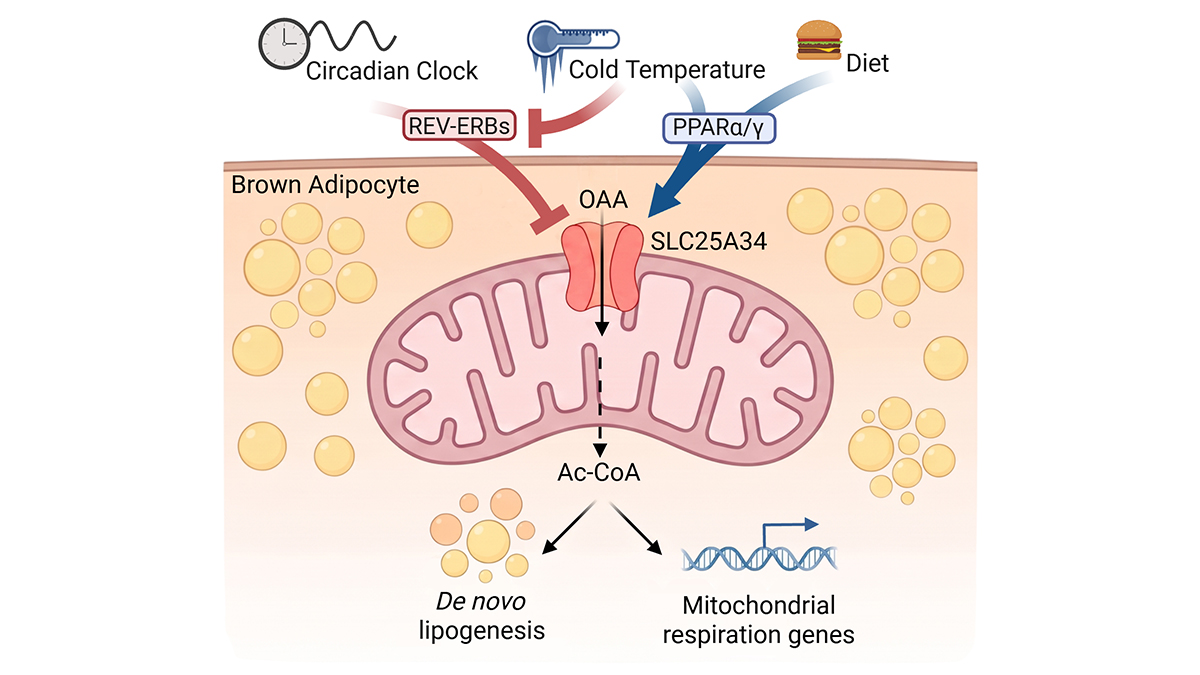
Maintaining body temperature is a critical requirement for all mammals. Multiple factors are involved in regulating the mitochondria in adipose cells. An international research team, led by Zachary Gerhart-Hines of the University of Copenhagen, studied the circadian, environmental, and dietary factors that regulate thermogenic fat in mice. They found that all of these factors converge on the mitochondrial metabolite transporter SLC25A34. The findings were recently published in the journal Science.
Mitochondrial Control of Heat Production in Fat
Maintaining body temperature is a critical requirement for all mammals. Multiple circadian, environmental, and dietary factors are involved in regulating the mitochondria in adipose cells to produce heat. An international research team, led by Zachary Gerhart-Hines of the University of Copenhagen, found that all of these factors converge on the mitochondrial metabolite transporter SLC25A34. The findings were recently published in the journal Science.
The production of heat by thermogenic adipose cells is regulated by circadian rhythms, but environmental factors, physical activity, and other factors can override the circadian control to more precisely match lipid metabolism to the immediate need. Interestingly, lipid metabolism in the brown adipose tissue can increase lipid synthesis in the cytosol and fatty acid b-oxidation in the mitochondria at the same time. How the body deals with the circadian rhythms and responses to acute cold are not understood.
The research team sought to clarify this complex regulation. They noted that Slc25a34 mRNA was expressed in a daily rhythm. During sleep the nuclear receptors REV-ERBα and REV-ERBβ cause histone deacetylase 3 to shut off expression of Slc25a34 mRNA. Upon waking, the repression is ended, and expression resumes. Other factors, such as cold or a lipid-rich meal, increase expression. The researchers used biochemical and metabolic tests to show that levels of SLC25A34 increase and decrease according to the body’s needs. The model they developed depends on the cycle of synthesis of lipids in the cytosol, and the oxidation of fatty acids in the mitochondria.
Their findings show that heat production by thermogenic fat tissue is controlled by multiple factors, but they all come together in the protein SLC25A34. This model greatly expands our understanding of this key physiological activity.
Statement of Significance by Dr. Gerhart-Hines
Fat cells have to reconcile two very different kinds of information: the predictable rhythm of the day and unpredictable changes in temperature and diet. We found that all three inputs converge on a single, previously uncharacterized mitochondrial carrier, SLC25A34. During sleep the clock holds it off through the REV-ERB repressors and HDAC3; waking, cold, and lipid-rich diets release that brake and switch the gene on through PPARα and PPARγ. Our data indicate that SLC25A34 brings oxaloacetate back into mitochondria, which keeps the TCA cycle turning and sustains the cytosolic acetyl-CoA needed to build new lipids. That is what allows thermogenic fat to make and burn lipid at the same time, an energy-dissipating cycle that has been recognized for years but whose timing and control were not understood.
A Conversation with Dr. Gerhart-Hines
MitoWorld: This study was an amazing team effort. Can you give us an idea of how you plan to further this work in the future?
Dr. Gerhart-Hines: Our first priority is to address direct transport at the biochemical level. Our metabolomics, compartment-resolved measurements, isotope tracing, and molecular docking all point to oxaloacetate import, but the definitive experiment is to reconstitute the purified carrier in liposomes and measure transport directly. That will also tell us whether N-acetylaspartate, malate, or other dicarboxylates are part of the picture. The second priority is to look beyond brown fat. At thermoneutrality, the heart has the highest Slc25a34 expression of any tissue we examined, followed by slow-twitch muscle, kidney, and several brain regions, and the REV-ERBs and PPARs that control it are active in all of them. Our third goal is to expand on understanding the human relevance of the transporter. Knocking down SLC25A34 in brown adipocytes from four donors reduced their respiratory capacity, and in subcutaneous white fat, its expression tracks with a healthier metabolic profile across 24 clinical studies. We now want to find out whether that relationship is causal.
MitoWorld: Body temperature is critical to mammals, and the regulation involved in these activities is exquisite with multiple players. SLC25A34 is one example. What is the next most-important question to resolve?
Dr. Gerhart-Hines: For SLC25A34, the question I most want answered is why it exists at all. Cells already have the malate-aspartate shuttle to move these carbon backbones between compartments, yet thermogenic fat switches on a separate, tightly regulated carrier that appears to run in parallel. Our working idea is that every time citrate or N-acetylaspartate is used to make cytosolic acetyl-CoA, an oxaloacetate is left behind in the cytosol, and SLC25A34 returns it to the matrix so the cycle can keep running at high flux. Proving that means defining what the carrier directly transports and in exchange for what. A related puzzle is its paralogue, SLC25A35. Both descend from the same yeast oxaloacetate carrier, but SLC25A35 is high at baseline in brown fat, falls in the cold, is not under clock control, and knocking it down did not affect respiration in our hands. Shingo Kajimura’s group recently linked it to phosphoenolpyruvate export for glycerolipid synthesis. Why mammals kept two versions with such different regulation is something I would love to understand.
MitoWorld: The final paragraph of the Discussion includes some intriguing speculations. For example, can you expand on the potential role of SLC25A34 in the brain?
Dr. Gerhart-Hines: I should stress first that this is speculation, since we have not done any experiments in the brain. The idea comes from N-acetylaspartate (NAA). When we depleted SLC25A34 in brown adipocytes, NAA was the most strongly changed metabolite, even after a single day, and the pattern fits NAA becoming trapped in the mitochondria, where it is made. NAA is best known from the nervous system. It is the second most abundant metabolite in the brain and supports myelination and neuronal integrity, and yet, how it leaves mitochondria has never been resolved. Slc25a34 is expressed in several brain regions, and so, it is reasonable to ask whether the carrier contributes to NAA handling there as it appears to in fat, either directly as a counter-exchange partner for oxaloacetate or indirectly. Testing that in neurons is an obvious next experiment, and one where we would be glad to receive some collaborative help from the neuroscience community.
MitoWorld: Might your findings have any clinical implications? If so, what might be the “low-hanging fruit”?
Dr. Gerhart-Hines: We need to be careful here because this was a mechanistic study done primarily in mice and cultured mouse and human cells. That said, the lipid cycle that SLC25A34 supports burns energy by design, and increasing that kind of cycling is one of the strategies being considered to counter the caloric excess of obesity by numerous pharmaceutical companies. The human data are encouraging: the carrier is needed for full respiratory capacity in human brown adipocytes, and higher expression in subcutaneous fat goes along with lower BMI, triglycerides, LDL cholesterol, and insulin resistance. Those are correlations, not proof. I don’t think the low-hanging fruit is a drug aimed at the carrier itself. Activating a transporter is hard, and with expression so high in the heart, we need to understand what it does there first. The nearer-term opportunities are to use SLC25A34 as a readout of lipid-cycling capacity in human fat, and to build on what we learned about its regulation. It is one of the most selective PPARα targets we found in brown fat, and it responds to time of day, cold, fasting, and dietary fat, so we can now ask when and how existing interventions engage this pathway.
MitoWorld: This paper has 65 authors. Can you give us an idea of how you organized such a large number of researchers at multiple institutions and in several countries?
Dr. Gerhart-Hines: This comprehensive project developed gradually from one question at a time over more than a decade. The seeds of the project were already planted while I was a postdoc with Mitch Lazar at the University of Pennsylvania. When I came to Copenhagen to start my lab in 2014 at the Novo Nordisk Foundation Center for Basic Metabolic Research, this initial discovery formed the basis of my first grant as an independent investigator. Iuliia Karavaeva, the first author, carried it for the better part of those years and was the one person who held the whole story in her head. Each time the data raised a question we could not answer ourselves, whether that was measuring a metabolite as unstable as oxaloacetate in separate cell compartments, isotope tracing, carrier structure, human brown adipocytes, or a particular mouse model, we went to the people who were experts in that area. That is how we ended up with colleagues in eight countries. What made it work was each collaborator’s passion for the science and their generosity in staying with us through the long haul. Being able to work with so many gifted and brilliant experts across disciplines was one of the highlights of this project for me.
MitoWorld: Mitochondria are involved in so many key cellular activities. How did you come to be interested in them?
Dr. Gerhart-Hines: I have been fascinated by mitochondrial biology since my PhD studies in Pere Puigserver’s group at the Dana-Farber Cancer Institute, where I worked on the sirtuins in muscle. Later, as a postdoc with Mitch Lazar, I studied how the circadian repressor REV-ERBα controls brown fat thermogenesis. When we went looking for factors controlled by both the molecular clock and cold, only two met every criterion: UCP1, the classic thermogenic protein, and an orphan carrier nobody had studied, SLC25A34. Both sit in the inner mitochondrial membrane and belong to the same SLC25 family. Once my work on the clock and fat tissue had converged on this uncharacterized mitochondrial transporter, I leapt at the opportunity to bring together many of my scientific interests in adipose metabolism, mitochondrial biology, and energy homeostasis. The result also made it clear to me that the decisions a fat cell makes about storing or burning energy are heavily shaped by what crosses that membrane. The project also highlighted how mitochondria play roles far beyond acting as the so-called ‘powerhouses of the cell’. Through metabolites like acetyl-CoA they also report back to the nucleus, and this carrier turned out to sit right at that interface.
Reference